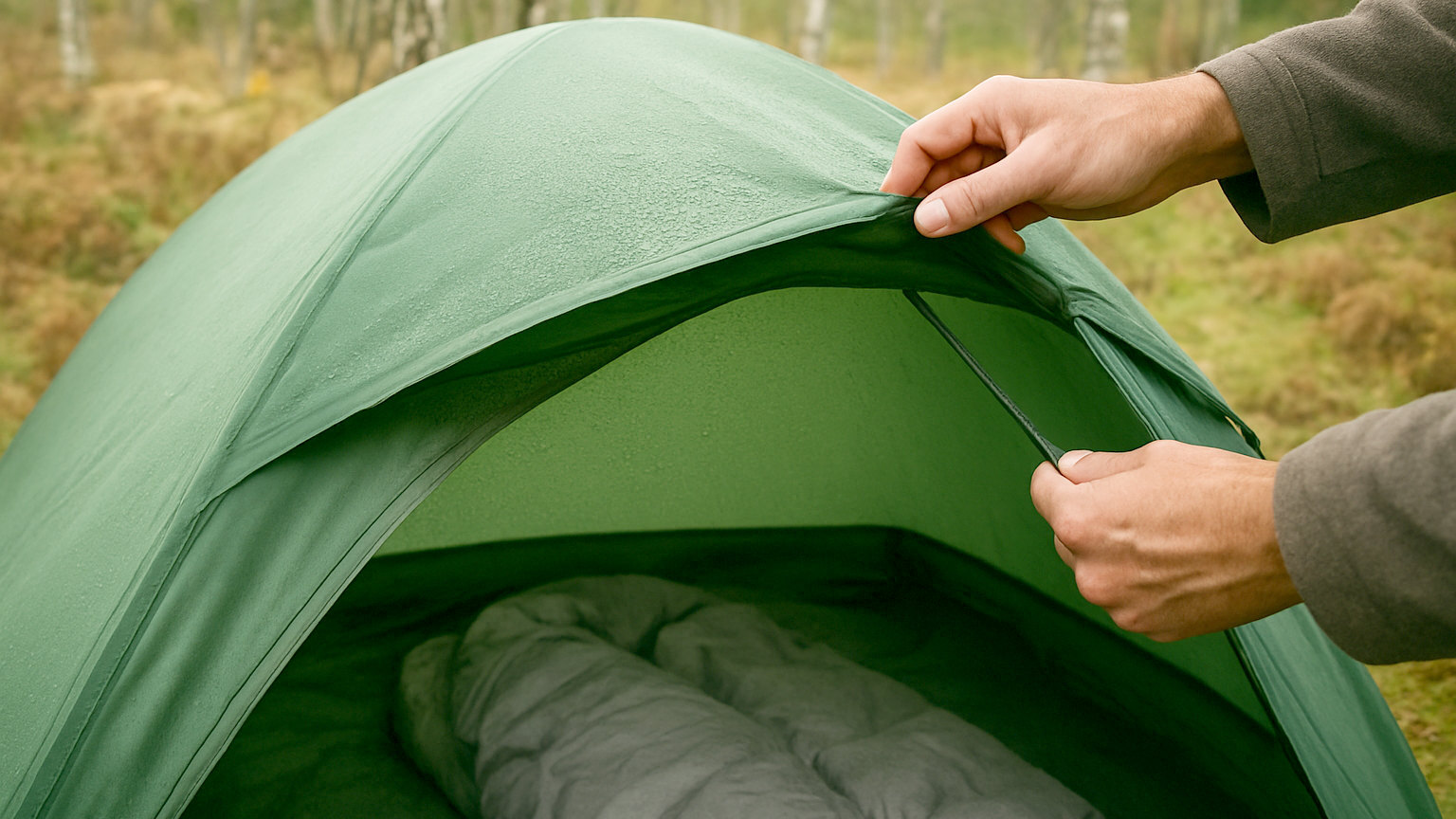
Waking to a wet tent inside and concluding it leaks is one of the most common camping misunderstandings. In most cases the water came from you.
Where does it come from?
Breathing, mostly. A person exhales roughly half a litre of water vapour overnight, and two people in a small tent produce a litre. Add moisture evaporating from damp clothing, wet boots in the porch and the ground beneath, and there is a considerable quantity of water vapour in a very small volume of air.
Why does it condense?
Because the flysheet is cold. Warm moist air inside meets fabric chilled by the night air, and the vapour condenses into droplets on the inside of the fly, exactly as it does on a cold window. It then drips or is knocked onto the inner tent, which is what people interpret as a leak.
- Most tent moisture comes from breathing, not from rain
- Open every vent, even when it is cold and wet
- Avoid pitching in hollows and beside water
- Keep wet clothing in the porch, not the sleeping area
- Do not touch the inner against the flysheet
- Single skin tents suffer far more than double skin
How do you tell it from a leak?
By where it is. Condensation forms evenly across the inside of the flysheet, particularly at the top and on the coldest side, and it appears as fine droplets. A leak produces water at a specific point, usually a seam, a zip, a pole sleeve or a worn patch, and it appears during rain rather than on a clear cold night. A clear still night with a wet tent is condensation.
What reduces it?
Ventilation, above everything else. Open every vent the tent has, keep the door partially unzipped where the weather allows, and resist the instinct to seal everything up when it is cold. A sealed tent is a warmer, wetter tent, and the marginal warmth is not worth waking in a damp sleeping bag.
Does the pitch matter?
Considerably. Hollows collect cold damp air, ground beside rivers and lakes is humid, and still sheltered sites have no airflow to carry moisture away. A slightly more exposed pitch with a breeze through the vents produces a dramatically drier tent, which is one of the few arguments against camping in the most sheltered spot available.
What about the inner touching the fly?
It transfers water directly. Where the inner tent is pushed against the wet flysheet, by wind, by sagging fabric or by kit stored against the wall, moisture wicks through and the inner becomes wet at that point. Pitch tautly, guy the fly out properly, and keep gear away from the walls.
What about single skin tents?
They suffer badly and it is inherent to the design. With no separate inner, condensation forms directly on the surface above you and drips onto your bag. Lightweight single skin shelters and tarps with bivvy bags all involve managing this. Some use breathable fabrics that help and none eliminate it in British humidity.
How do you deal with it in the morning?
Wipe the fly down with a cloth before packing, which removes a surprising amount of weight and water. Shake the tent out. If you can, hang everything to dry at the next stop rather than packing it damp repeatedly. Keep the sleeping bag away from the walls overnight so it does not absorb moisture in the first place.
Does the season affect it?
Considerably. Cold clear nights are the worst, because the flysheet radiates heat to the sky and becomes colder than the air, so condensation forms heavily even in dry conditions. Windy nights are the best, since airflow carries the moisture away. This is why a still frosty night frequently produces a wetter tent than a breezy rainy one.
Expect condensation rather than blaming a leak, ventilate aggressively, avoid hollows and waterside pitches, pitch tautly, and wipe the fly before packing.