Wind is the condition most likely to destroy a tent and the one people most often pitch into without adjustment. The measures are simple and need doing before it gets dark.
Where should you pitch?
Behind something. A wall, a bank, a boulder, a fold in the ground or the lee of a hillside reduces wind enormously and matters more than having level ground. Avoid ridges, cols, summits and open plateaux entirely. Do not pitch under trees, since branches come down, and be aware that valleys funnel wind rather than sheltering from it.
How should the tent face?
Smallest and strongest end into the wind, with the door in the lee so it does not scoop air. Tunnel tents must have the tail into the wind and will fail if pitched side on. Remember that wind direction shifts overnight, particularly in valleys where it drains downhill after dark, so allow for a change rather than optimising for the current direction.
- Find shelter before you worry about level ground
- Strongest end into the wind, door in the lee
- Use every guy line and every peg, angled at forty five degrees
- Weight the inside with your pack and gear
- Keep everything loose inside or weighted down
- Be prepared to move or drop the tent if it is failing
How do you secure it properly?
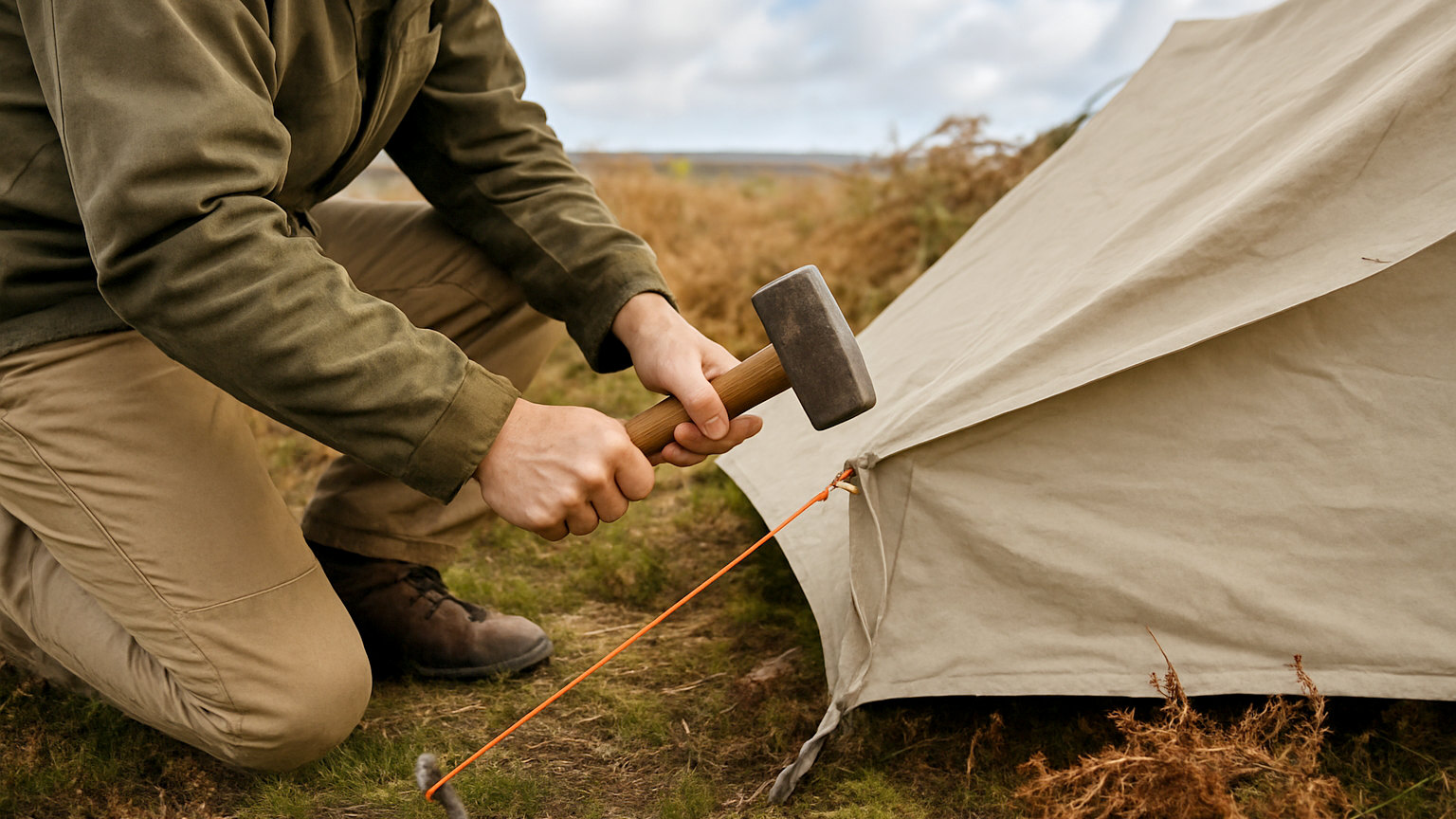
Every guy out, every peg used, pegs angled away from the tent at around forty five degrees and pushed fully in. Add stones on top of pegs in soft ground, or bury them sideways as deadmen. Guys should be taut but not straining, since a drum tight tent transmits every gust into the fabric and poles rather than flexing.
What about your gear?
Keep it inside or weighted. Anything loose outside a tent in wind is gone: mats, stuff sacks, clothing on a line, cooking equipment. Weight the tent down with your rucksack and heavy items, particularly if you leave it during the day, and never leave a lightweight tent pitched and empty in wind.
What does a failing tent look like?
Poles bending further than they should and not recovering, fabric snapping violently, guy points tearing, or the whole structure flattening in gusts. If a pole breaks, the fabric usually tears shortly afterwards. Noticing early gives you options, and noticing at three in the morning when it collapses does not.
What should you do if it is failing?
Get dressed and get your kit into bags before anything else, so that if the tent goes you are not standing in a gale in base layers with everything loose. Then either move to a more sheltered spot or take the tent down deliberately and use it as a bivvy, lying on it and under it, which is far better than fighting a collapsing structure.
How do you sleep through it?
Earplugs, and accepting that you will not sleep much. Wind noise in a tent is far louder than the actual conditions suggest and produces a night of poor sleep and anxiety. A well pitched tent in a sheltered spot handles far more than it sounds like it is handling, and knowing that helps.
When should you not camp at all?
When the forecast gives sustained high winds on exposed ground, particularly with rain. A night out in a failed tent on a hillside is a genuine emergency, and choosing a lower, more sheltered valley site, a campsite, or a different weekend is a much better outcome than testing the equipment. Check the mountain forecast for gust speeds specifically.
What about the forecast?
Check gust speeds rather than average wind, since it is the gusts that break tents and they can be substantially higher than the mean figure. Mountain forecasts give both. A forecast of moderate average wind with severe gusts is a reason to find a sheltered valley site rather than a high pitch, however good the view.
Pitch behind shelter, strongest end into the wind, use every guy and peg, weight it down, and be ready to move or drop it rather than fight it.