The saw is the most useful and least glamorous cutting tool in bushcraft. It does more camp wood work than an axe, with less effort and far less risk.
Why is a saw better for most tasks?
Because it cuts across the grain efficiently and it cannot glance. Sawing a log to length is faster than chopping it, produces less waste, requires far less energy, and the blade travels in a controlled line rather than on an arc that could reach your leg. For processing found wood into burnable lengths, nothing else compares.
What type should you buy?
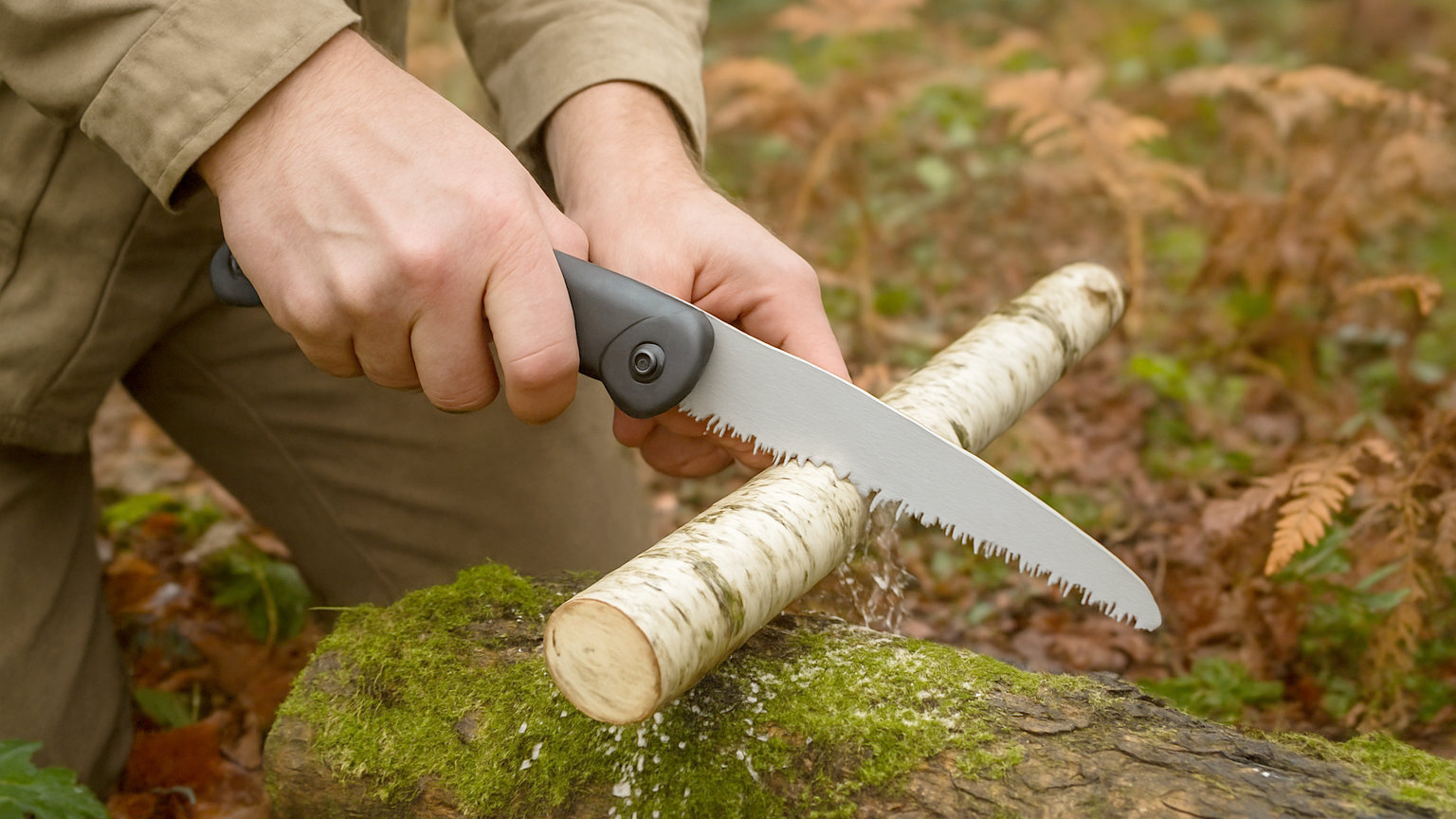
A folding pruning saw, for almost everyone. They weigh little, fold safely closed, cost modestly and cut aggressively on the pull stroke. Blades are typically twenty to twenty five centimetres, which handles wood up to roughly the diameter of a wrist comfortably and larger with patience. They are the standard tool carried by people who spend a lot of time in woodland.
- A folding pruning saw suits almost all camp tasks
- Bow saws cut larger wood faster but are bulky
- Most modern blades cut on the pull stroke
- Let the saw do the work rather than pressing hard
- Watch for wood under tension pinching the blade
- Keep the blade dry and replace it rather than sharpening
When is a bow saw better?
For volume and for larger diameters. A bow saw cuts substantially faster through thicker wood and is the right tool for a base camp processing a serious quantity of firewood. It is bulky, awkward to carry and the frame catches on everything, which makes it a poor choice for walking in with. Take one to a fixed camp and leave it at home otherwise.
How do you saw efficiently?
Long steady strokes using the full length of the blade, with light pressure, letting the teeth cut. Pressing hard slows the cut, tires you and bends the blade. Start with a shallow pull to establish a groove, using your thumb knuckle as a guide rather than your thumb pad. Keep the blade straight rather than twisting, which binds it.
What about wood under tension?
It is the main hazard. A branch supported at both ends closes onto the blade as you cut and traps it, while one that is bent springs when released. Read which way the wood will move before cutting, cut a relief on the compression side first, and never stand where a springing branch would reach you. Fallen trees in particular hold enormous tension.
How do you keep it working?
Dry and clean. Modern hardpoint teeth are hardened and cannot be sharpened by users, so blades are consumables to be replaced rather than maintained. Wipe sap off with a solvent, dry the blade before folding it away, and a light oil prevents rust. Blades cost little and a fresh one transforms a saw that has become hard work.
Is a wire or chain saw worth carrying?
The pocket wire saws sold in survival kits are close to useless, breaking quickly and cutting poorly. Chain pocket saws with proper chainsaw links are considerably better and still slower and more awkward than a folding saw for the same weight. If you want a small saw, buy a decent folding one.
What about the law?
Cutting living wood without permission is criminal damage and taking wood is theft, regardless of how plentiful it looks. In practice this means collecting dead fallen wood where you have permission to be and to gather, which many permissive sites allow and many do not. Ask rather than assume, and never cut standing trees.
How do you cut safely?
With the work supported and your hands clear of the blade line. Support the piece against a log, a fork or the ground so it does not roll, and keep the hand steadying it well away from the cut, ideally holding the far end rather than beside the blade. Start the cut with the blade angled slightly and your knuckle as a guide, then flatten out once a groove is established.
Buy a folding pruning saw, use long light strokes, read the tension before cutting, keep the blade dry, and replace blades rather than sharpening them.