
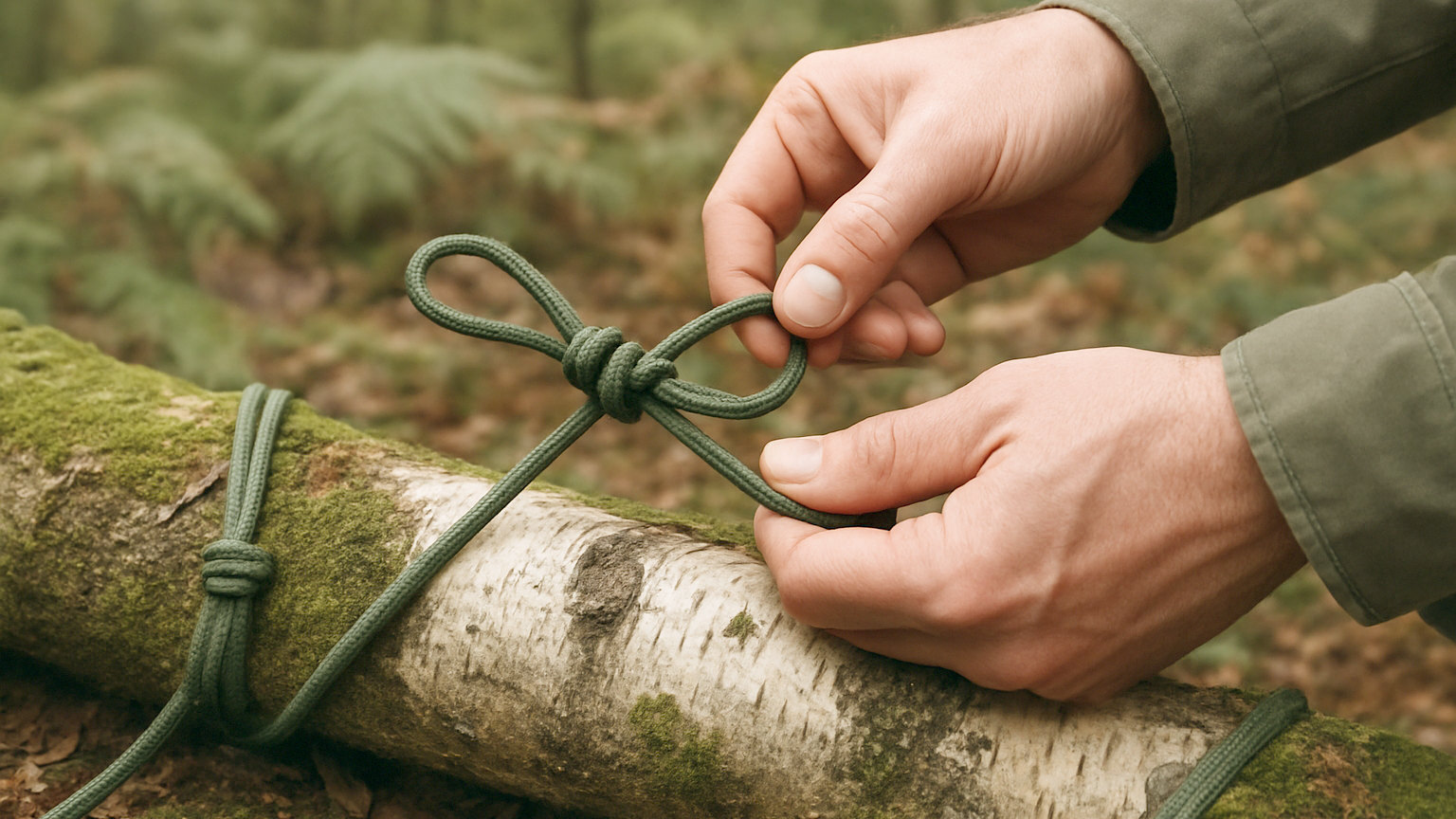
Knot books contain hundreds and camping requires about six. Learning those to the point of tying them without thinking is worth far more than a passing familiarity with fifty.
Which knots earn their place?
A bowline for a fixed loop that will not slip and unties easily after loading. A taut line hitch for an adjustable guy line. A trucker hitch for tensioning a ridgeline hard. A clove hitch or timber hitch for attaching to a pole or a tree. A double fisherman for joining two lines. A figure of eight as a stopper. Those six handle almost every situation you will meet.
What does each do?
The bowline puts a reliable loop in the end of a rope, holds under load and comes undone afterwards. The taut line hitch slides along the standing part to adjust tension and grips when loaded, which is what tent guys need. The trucker hitch creates a mechanical advantage of roughly three to one for pulling a ridgeline tight. The timber hitch grips a round object and tightens under load.
- Bowline: a fixed loop that unties after loading
- Taut line hitch: an adjustable guy line
- Trucker hitch: tensioning a ridgeline
- Clove hitch or timber hitch: attaching to a pole or tree
- Double fisherman: joining two lines
- Figure of eight: a stopper that does not jam
How do you learn them properly?
Repetition until they are automatic, then repetition in awkward conditions. Tie each one twenty times in a session while watching television, then tie them behind your back, then in the dark, then with cold hands and gloves on. The test is whether you can tie it when you are tired, wet and it is dark, which is when you will need to.
Why does untying matter?
Because a knot that jams under load is a knot you cut off, and cordage is not infinite. The bowline and the figure of eight are valued specifically because they come undone after being heavily loaded. Overhand knots and granny knots jam solid and are the reason people end up with a rope full of permanent lumps.
Does the cordage change the knot?
Considerably. Slippery modern lines such as dyneema hold knots far less securely than nylon or natural fibre, and knots that are entirely reliable in paracord can creep or slip in thin slick cord. Where you use low stretch guyline, check what the manufacturer recommends and add a stopper or an extra turn where slipping is a concern.
What about tarp rigging specifically?
A ridgeline tensioned with a trucker hitch, tied off at each end with a bowline or a timber hitch, with the tarp attached by prusik loops or toggles so it can slide, and guys secured with taut line hitches. That combination pitches almost any tarp configuration and adjusts without retying anything, which matters when the wind changes at two in the morning.
What about a prusik?
A friction hitch made from a loop of thinner cord that grips a rope when loaded and slides when not, which makes it excellent for attaching a tarp to a ridgeline at adjustable points. It is worth learning as a seventh knot because it solves a specific problem elegantly and takes ten minutes to master.
What should you avoid?
Reef knots for joining two ropes, which is a common and genuinely dangerous misuse since they capsize and fail under load. Use a double fisherman or a sheet bend instead. Also avoid learning knots from a static diagram alone, since the tucking is much easier to follow in motion.
Does dressing a knot matter?
Considerably, and it is the step beginners skip. Dressing means arranging the parts of a tied knot so they sit neatly alongside each other rather than crossed, then tightening it evenly. A badly dressed knot is weaker, more likely to jam and more likely to slip, and the difference between a tidy bowline and a messy one is genuinely measurable.
Learn a bowline, taut line hitch, trucker hitch, timber hitch, double fisherman and figure of eight, and practise until you can tie them in the dark.


