Knife injuries in bushcraft are predictable. In almost every case the blade travelled along the line it was always going to travel along, and something was in the way.
What is the blood circle?
The area you can reach with the knife at arm length in any direction, sometimes called the blood bubble or the triangle of death when referring to the space between your thighs. Nobody else should be inside it while you are cutting, and none of your own limbs should be in the path of the blade. Establishing this habit prevents most injuries.
What is the basic rule?
Before every cut, work out where the blade goes if it slips or if the wood suddenly gives, and make sure nothing important is there. Wood behaves unpredictably, knots deflect the edge, and the moment the resistance disappears the knife accelerates. Planning for that rather than for the intended cut is the whole of knife safety.
- Know where the blade goes if it slips, before you cut
- Keep both legs out of the line of the cut
- Nobody within arm length plus blade length
- Cut away from yourself unless using a controlled grip
- Sit or kneel stably rather than cutting while walking
- Sheathe it the moment you stop using it
Where should you sit?
Somewhere stable, with your work supported and your legs out of the way. Sitting with elbows braced on knees and cutting downward into the gap between the legs is how people cut a femoral artery. Sit to one side of the cutting line, brace the work against a log or your knee with the blade travelling past your body rather than toward it.
What are the controlled grips?
Techniques where the blade cannot travel far because the movement is constrained. The chest lever, where the knife is held reversed against the chest and the arms open to draw the blade through, gives great power and short travel. The thumb push, where the thumb of the opposite hand pushes the back of the blade, gives fine control. Both are taught on any course and are worth learning properly rather than from description.
Why is a blunt knife dangerous?
Because it requires force, and force removes control. A sharp knife cuts where you put it with light pressure. A blunt one needs shoving, skids off the surface, and travels a long way when it finally bites or slips. Every serious injury caused by a blunt knife involved someone pushing harder than they should have needed to.
What about batoning?
Split with the blade fully through the wood and struck on the exposed spine, using a wooden baton rather than a rock or another knife. Keep your hand behind the handle rather than over the blade, work on a stable base, and stop if the knife jams rather than levering it hard, which snaps blades. Do not baton a folding knife, which is not designed for it.
What do you do about cuts?
Carry a first aid kit with proper dressings and know how to apply firm pressure. Bushcraft cuts tend to be deep and clean, they bleed convincingly, and direct sustained pressure controls almost all of them. Anything gaping, anything on a hand where movement is affected, and anything that will not stop bleeding needs medical attention rather than a plaster.
How do you build the habit?
By narrating it to yourself until it is automatic. Before each cut, where does it go if it slips. Doing that consciously for a few sessions embeds it, and after that you notice unsafe positions without thinking. Instructors do this constantly, which is one reason a course is worth more than a book here.
What about gloves?
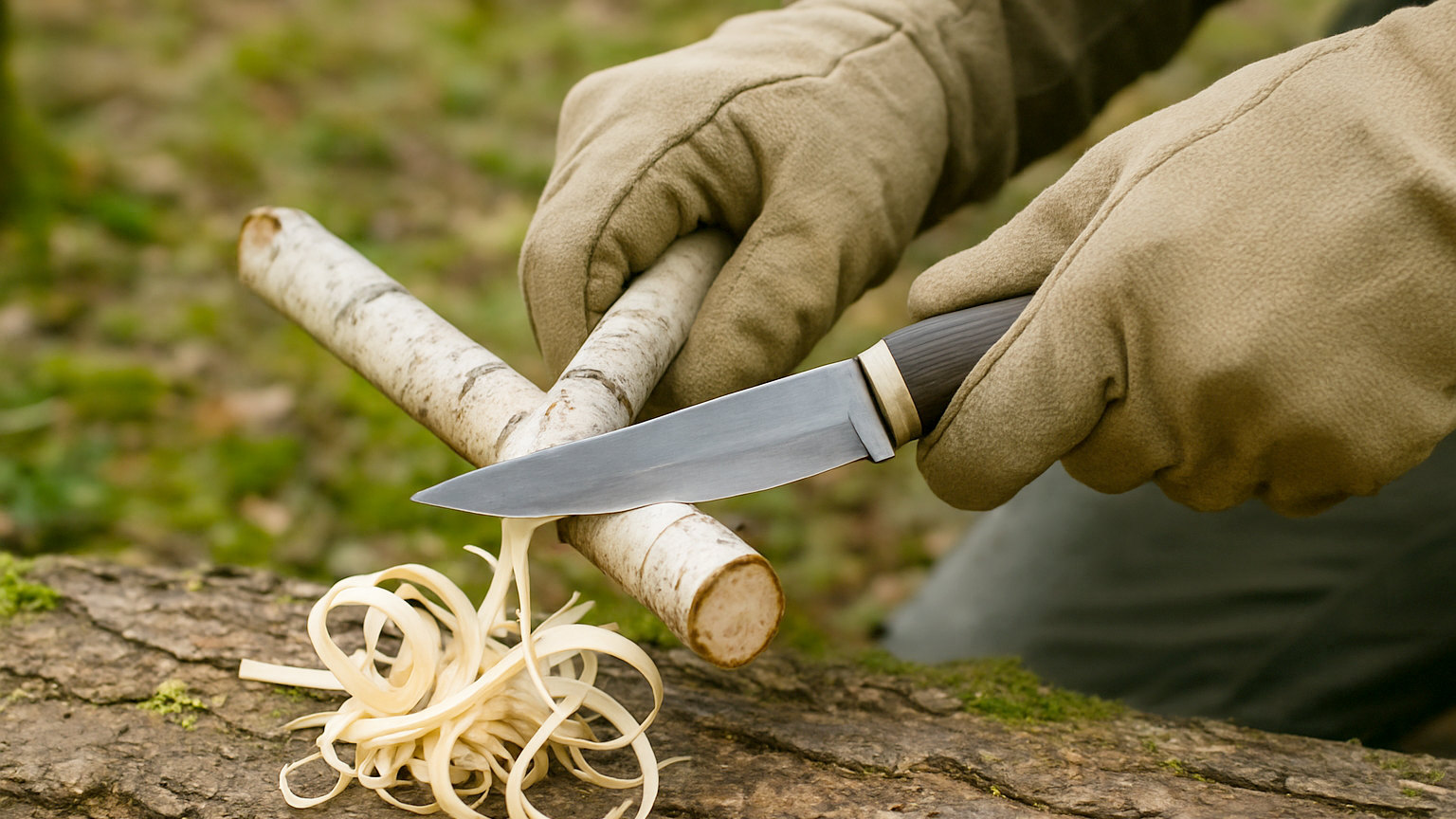
A cut resistant glove on the non knife hand is sensible for carving, particularly while learning, and it is not a substitute for technique. It protects against the glancing contact that produces most minor cuts and will not stop a knife driven with force. Do not wear a loose glove on the knife hand, which reduces grip and control.
Work out where the blade goes if it slips before every cut, keep your legs out of the line, sit stably, keep it sharp, and sheathe it when you stop.