
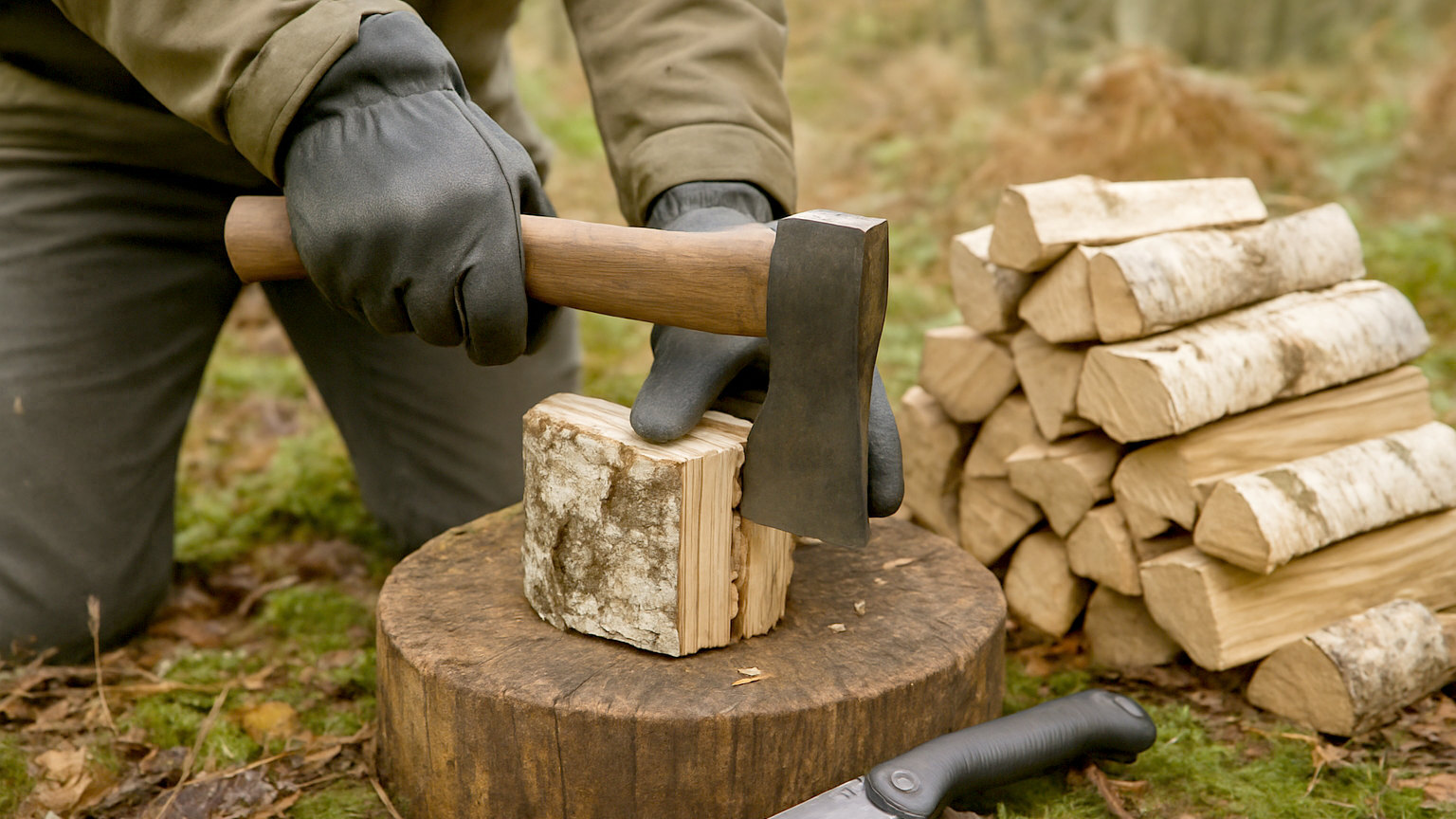
Fire lighting gets the attention and wood preparation determines whether the fire works. Gathering and processing properly is most of the job.
Where do you find dry wood?
Standing dead, off the ground. Dead branches still attached to a tree, or caught in the canopy, are far drier than anything lying on the woodland floor, which absorbs ground moisture continuously. Snapping a branch tells you a great deal: dry wood cracks cleanly while damp wood bends and tears. Look upward rather than downward.
How should you size it?
In graded sizes, prepared before lighting. Tinder that takes a spark. Kindling the thickness of a match, then a pencil, then a thumb. Then wrist thick fuel. Gather considerably more of the small sizes than you think you need, since that is where fires fail. Having everything sorted into piles before striking a spark is what separates reliable fire from frustration.
- Take standing dead wood rather than wood off the ground
- Snap a piece to test: dry cracks, damp bends
- Grade it into tinder, kindling and fuel before lighting
- Gather far more small material than seems necessary
- Saw to length rather than chopping where possible
- Split wet wood to reach the dry interior
Why split wet wood?
Because the inside is dry. Rain penetrates only a little way into standing dead wood, so a piece that is soaked on the outside frequently has entirely usable material at the core. Splitting it exposes that, and shavings taken from the split face light readily. This is the single most useful technique for making fire in British conditions, where everything is damp.
How do you split without an axe?
By batoning with a knife. Place the blade across the end grain, strike the exposed spine with a wooden baton, and drive it through. Keep the blade fully across the wood rather than at an angle, use a stable base, and stop and reposition rather than levering hard if it jams. A ten centimetre fixed blade will split wood considerably thicker than you would expect.
What is a feather stick?
A stick shaved into a mass of thin curls still attached at the base, which presents a great deal of dry surface area and catches a flame readily. It is the standard answer to wet conditions when no tinder is available, since the curls come from the dry interior of split wood. Making a good one requires a sharp knife and practice, and it is a genuinely useful skill.
Where should the fire go?
On mineral soil or a raised platform, well away from anything that could carry fire. Never on peat, which burns underground for weeks and is close to impossible to extinguish. Never against a tree, over roots, or beneath overhanging branches. Clear a wide area of leaf litter, and keep water to hand before lighting rather than afterwards.
How do you leave it?
Cold and unrecognisable. Drown the fire with water until there is no steam, no hiss and no warmth when you hold a hand over it, then stir the ashes and drown it again. Scatter cold ashes widely, replace any turf or soil, and leave no scar. A fire that looks out can reignite hours later, which is how moorland fires start.
What about permission?
Assume you do not have it unless told otherwise. There is no general right to light fires in England and Wales, and byelaws prohibit it on most public land. Taking wood without permission is theft even where it is dead and plentiful. Use a raised fire bowl on land where you have permission, and check fire severity warnings during dry periods.
How much do you need?
Considerably more than you gather on the first attempt. A rough guide is to collect what you think you need for an evening, then collect the same again, and expect to use most of it. Fires consume wood faster than beginners anticipate, and running out at eleven at night means gathering in the dark, which is unpleasant and unsafe. Gather in daylight for the whole night.
Take standing dead wood, grade it before lighting, split wet wood to reach the dry core, keep fire off peat and roots, and drown it thoroughly.


