Making cord from plants is one of the more satisfying bushcraft skills and one of the least practically necessary, since a few metres of manufactured line weighs almost nothing. It is worth doing once for what it teaches.
Which materials work?
Nettle stems, which produce fine strong fibre and are abundant. Lime bast, the inner bark of lime trees, which is the traditional European cordage material and makes excellent rope. Willow bark. Bramble, after the thorns are stripped. Various grasses and rushes for coarse work. Nettle and lime are the two most worth learning.
How do you prepare nettle?
Cut tall stems late in the season, remove the leaves by running a gloved hand up the stem, then split the stem lengthways and open it flat. Crush the woody core gently and peel it away, leaving the fibrous outer layer. Let that dry, then work it between your hands to soften and separate the fibres. The whole process takes a while and produces a surprisingly small quantity.
- Nettle and lime bast are the most productive materials
- Harvest late in the season when fibres are strongest
- Separate fibre from the woody core and dry it
- Reverse wrap two bundles to make cord
- Splice in new material before a bundle runs out
- Expect it to take far longer than you think
What is retting?
Soaking plant material so that bacteria break down the tissue holding the fibres together, making them far easier to separate. Lime bast is traditionally retted by submerging it in water for several weeks, after which the bast peels into long ribbons. It smells unpleasant and it transforms the material, and it is why traditional cordage making was a seasonal activity rather than something done on the spot.
What is the reverse wrap?
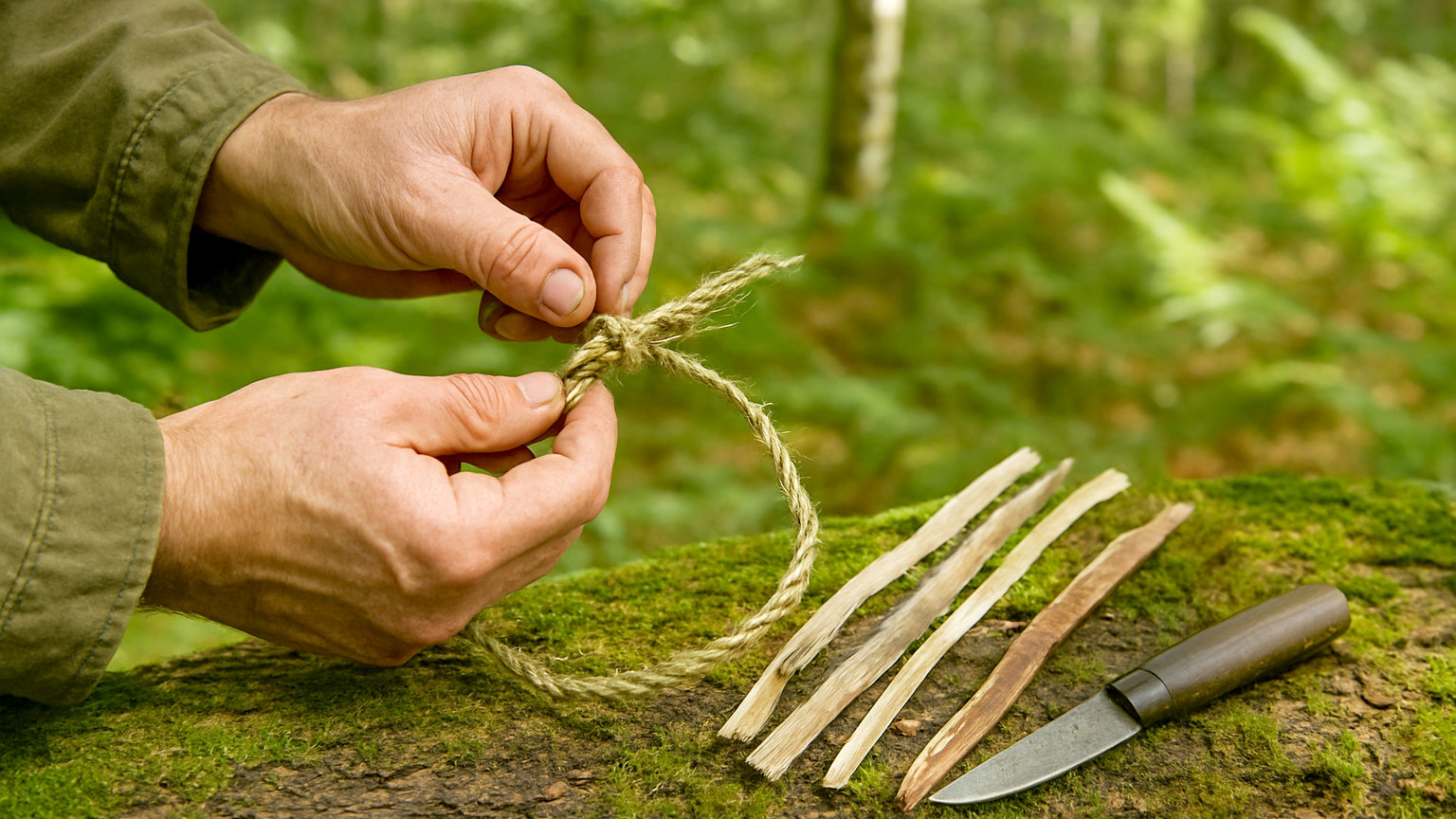
The standard technique for twisting fibre into cord. Take a bundle, twist one half away from you until it kinks, then bring the far strand over the near one toward you, and repeat. The twist in each strand and the opposite twist between them lock together, which is what stops the cord unravelling. It is easier to demonstrate than to describe and takes minutes to learn.
How do you make it longer?
By splicing in new fibre before a bundle runs out, staggering the joins so both strands do not end at the same point. Lay new material alongside the thinning strand with an overlap and continue wrapping, and the twist holds it. Done properly the join is invisible and no weaker than the rest, and cord of any length can be made continuously.
How strong is it?
Stronger than people expect and far weaker than manufactured line. Well made nettle or lime cord will take a substantial pull and is entirely adequate for lashings, snares where legal, bindings and general camp use. It is not suitable for anything bearing body weight, and it weakens when wet and degrades over time. Test any natural cordage before trusting it.
Is it worth learning?
As craft, yes, and as preparation, marginally. The genuine value is understanding how fibre and twist work, which changes how you look at plants and at rope. As a practical measure it is dramatically slower than carrying cord, and anyone in a situation requiring improvised cordage has other priorities. Do it because it is interesting.
What else can you use?
Roots, particularly spruce roots, which are traditionally used for stitching birch bark and lashing, and which are strong and flexible when split. Rushes and grasses for coarse binding. Strips of bark used directly without twisting for lashing poles. Improvisation with what is available is much of the skill.
What about testing it?
Test every piece before you rely on it, since natural cordage varies enormously with material, preparation and how evenly it was wrapped. Pull it hard between your hands and look for thin sections, which are where it will fail. Never use it for anything supporting body weight, and remember it loses strength when wet and degrades with age and sunlight.
Try nettle or lime bast, separate and dry the fibre, learn the reverse wrap, splice in new material before you run out, and do it for the understanding.