Being caught by a vegetation fire is survivable and the decisions are counterintuitive. Almost every fatality involves someone moving in the wrong direction.
Why is uphill so dangerous?
Because fire travels dramatically faster uphill. Flames preheat and dry the fuel above them, and hot gases rise into it, so the rate of spread increases sharply with slope. A fire can move several times faster up a hillside than on flat ground, easily outpacing a person. Retreating uphill ahead of an advancing fire is the single most common fatal decision.
Which way should you go?
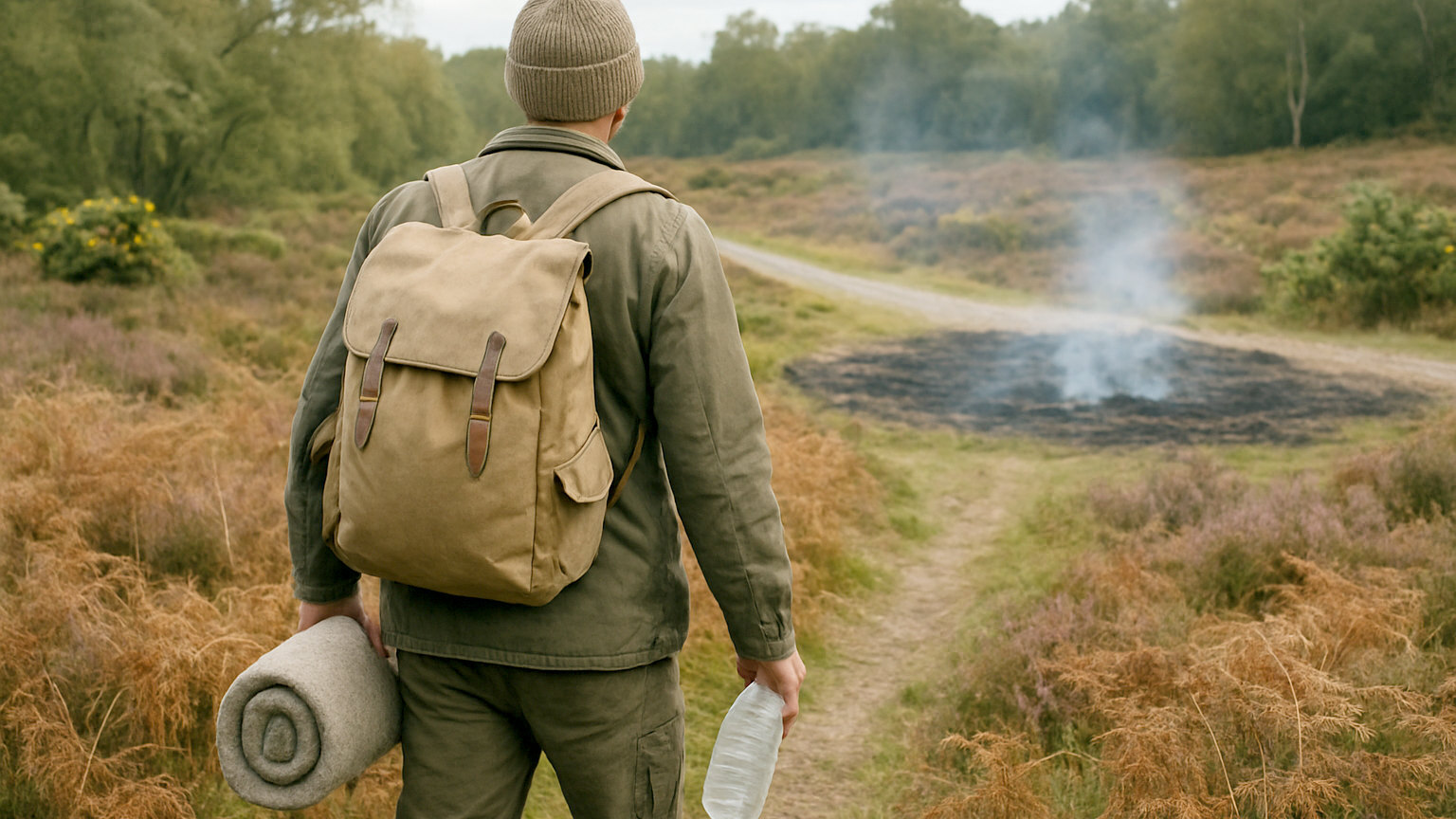
Downhill and across the wind, at an angle to the direction of spread rather than directly ahead of it. The aim is to get out of the path rather than to outrun the front. Look for a road, a track, a large area of bare ground, water, or ground that has already burned, which cannot burn again and is the safest place available.
- Never move uphill ahead of an advancing fire
- Move downhill and across the wind, out of the path
- Head for burnt ground, roads, bare earth or water
- Avoid gullies, saddles and steep narrow valleys
- Cover your airway and keep low, where the air is clearer
- Call 999 and give your position if you can
What should you avoid?
Gullies, ravines, saddles and narrow steep valleys, which channel fire and accelerate it in the same way a chimney does. Also dense vegetation such as gorse and conifer plantation, which burns fiercely and gives no escape route. Do not shelter in a building unless it is substantial and you have no alternative, and never in a wooden or thatched structure.
Why is burnt ground safe?
Because the fuel has gone. An area that has already burned cannot carry fire again, which makes it the most reliable refuge available on open land. Getting into the black, as fire crews describe it, means crossing the fire edge where it is low and slow, which requires nerve and is a recognised survival technique. Do not attempt it through an active flame front.
What if the fire reaches you?
Get as low as possible in the least combustible place you can find. A ditch, a hollow, a stream bed, a road, or bare rock. Cover exposed skin with clothing, since radiant heat causes most burns, and cover your mouth and nose with fabric, ideally damp. Lie face down and shelter your face and airway with your hands. Fire fronts in grass pass quickly.
What about smoke?
It is the main immediate threat and it sits above you. Air near the ground is cooler and clearer, so staying low genuinely helps. Breathe through fabric, take slow controlled breaths and move perpendicular to the smoke drift where you can. Disorientation in smoke is a serious risk, which is why knowing which way is downhill matters.
What if you are in a vehicle?
Staying in it is generally safer than running. Park in a clear area away from vegetation, close windows and vents, turn on hazard lights, get below the window line and cover yourself with anything non synthetic. Vehicles rarely explode, contrary to the impression films give, and the body provides substantial protection from radiant heat as a front passes.
What should you do afterwards?
Get clear, seek medical attention for any smoke inhalation, and tell the emergency services where you are. Smoke inhalation can worsen over hours, so breathing difficulty, persistent coughing or a hoarse voice after exposure warrants assessment even if you feel reasonably well at the time.
How fast can a grass fire move?
Faster than people run, in the wrong conditions. Fire in cured grass with wind behind it moves at a speed that surprises everyone who has not seen it, and on a slope it accelerates further. The practical consequence is that judging whether you can get ahead of a fire is not a safe calculation, and the correct response is to move out of its path rather than to try to outpace it.
Go downhill and across the wind, aim for burnt ground or bare earth, avoid gullies, stay low, and stay in the vehicle if you are in one.