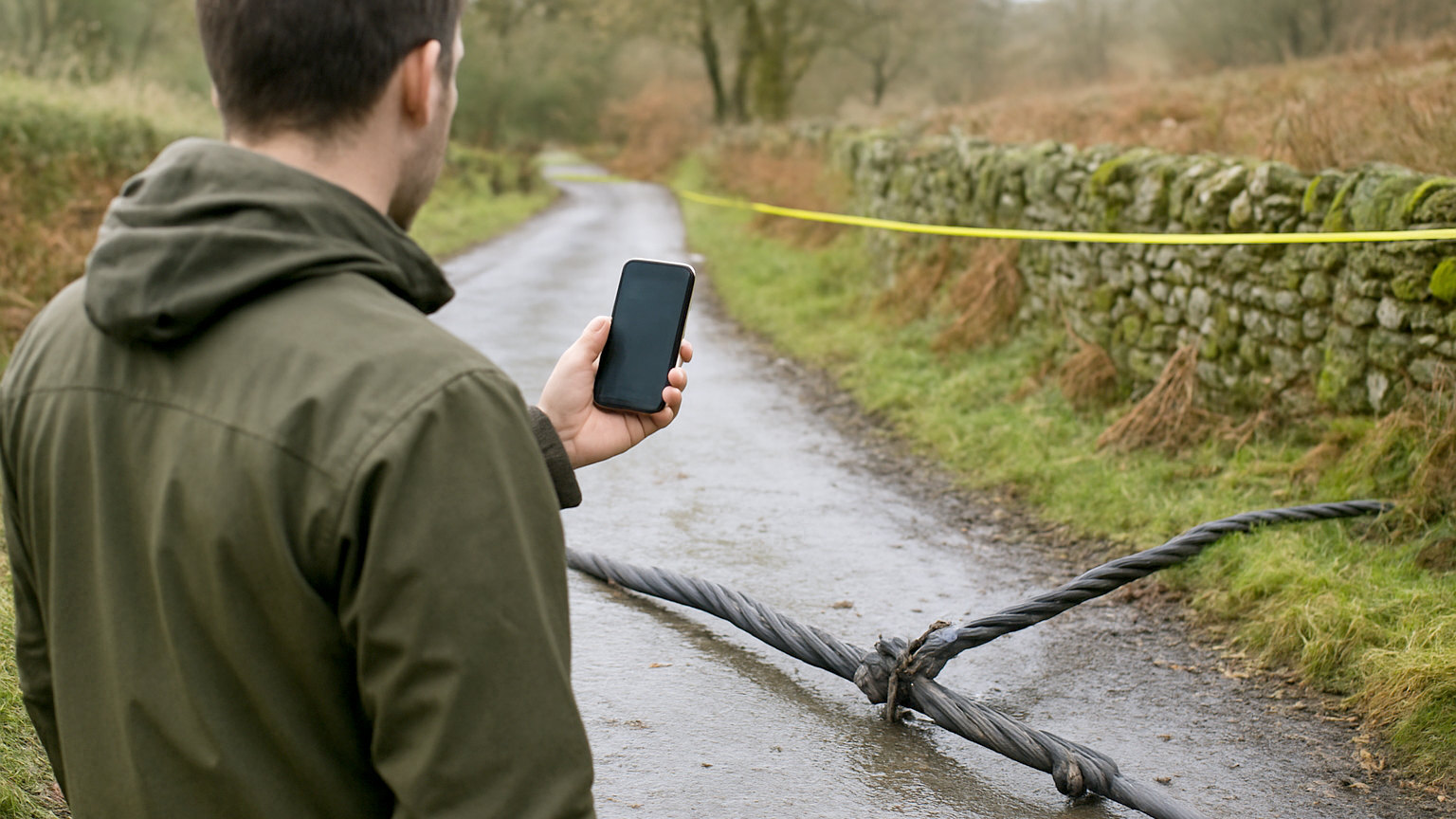
Storms bring down cables every winter, and the correct response is simple and absolute: stay away and report it. The reason the distance matters is not obvious and is worth understanding.
Why must you assume it is live?
Because you cannot tell by looking, and because networks attempt to restore supply automatically. Overhead systems include automatic reclosers that re energise a line after a fault, so a cable that appears dead may become live without warning. A line on the ground giving no sign of activity should be treated exactly as one arcing and sparking.
How far should you stay away?
Well back, and further than feels necessary. Guidance is to keep at least several metres clear, and considerably more for high voltage lines, since electricity can arc through air and spread through the ground. Keep people, children and animals away, and do not attempt to move anything in contact with the cable, including branches, fencing or vehicles.
- Assume every fallen cable is live, always
- Keep well clear and keep others back
- Do not touch anything in contact with the cable
- Call 105, or 999 if there is danger to people
- If a cable falls on your vehicle, stay inside
- Never attempt to move a line or a tree touching one
What is step potential?
The reason ground near a fallen line is dangerous even without touching it. Current from a downed cable spreads outward through the earth, creating a voltage gradient. Stepping across that gradient puts your feet at different voltages and drives current through your body. This is why you keep back rather than walking up to look, and why livestock in a field with a downed line are at risk.
What if you are already close?
Move away with small shuffling steps, keeping your feet together and in contact with the ground, rather than taking normal strides. That keeps both feet at approximately the same voltage and avoids completing a circuit. It looks odd and it is the correct technique, taught to utility workers for exactly this situation.
What if a cable falls on your car?
Stay inside and call for help. The vehicle body conducts current around you, and stepping out puts you in contact with both the car and the ground simultaneously, which is the dangerous combination. Wait for the network operator to confirm the line is isolated. Only if the vehicle is on fire should you leave, and then by jumping clear without touching the car and the ground at once, landing with feet together.
Who do you call?
105 connects you free to your local electricity network operator from any phone and is the correct number for a downed line or a power cut. Call 999 instead if there is immediate danger to people, if anyone has been injured, or if there is a fire. Give a precise location, describe what you can see, and stay on the line if asked.
What about lines onto your property?
The service cable from the network to your house is the network responsibility up to the cutout, and the wiring beyond it is yours. A damaged service cable, a cable pulled from a wall, or a bracket torn away by a falling branch should be reported through 105 and not touched. Do not attempt any repair or make it safe yourself.
What else should you avoid after a storm?
Anything electrical that has been in water or in contact with a damaged supply. Do not reconnect appliances that have been wet, do not use a generator connected to house wiring, and have the installation inspected if water reached the consumer unit. Report any burning smell, arcing or flickering that persists after supply is restored.
What about lines that are down but not obvious?
Look up as well as around after a storm. A cable can be brought low by a fallen branch without touching the ground, leaving it at head height across a path, a field or a driveway where it is easy to walk into, particularly in poor light. Cables lying in standing water or hidden in undergrowth carry the same danger with none of the visibility. Treat any sagging or displaced line as a hazard and report it.
Assume it is live, keep well back, shuffle away with feet together if you are close, stay in the car if one falls on it, and call 105 or 999.