How an infection spreads determines which precautions work. For respiratory illness the picture became considerably clearer over recent years, and it changes what is worth doing at home.
What is the main route?
Air. Infected people exhale particles containing virus across a continuous range of sizes, from large droplets that fall quickly to fine aerosols that remain suspended and drift. Both matter, and the distinction between them is a spectrum rather than two categories. Breathing that air is the dominant route for most respiratory infections.
Where does risk concentrate?
Indoors, close together, for extended periods, with poor ventilation, and where people are talking loudly, singing or exercising. Those factors multiply. A crowded poorly ventilated room for an hour presents very different risk from a brief outdoor conversation, and understanding that lets you make sensible judgements rather than applying the same precautions everywhere.
- Exhaled particles across a range of sizes are the main route
- Indoor, crowded, prolonged and poorly ventilated is the risk profile
- Outdoors is dramatically lower risk than indoors
- Surfaces matter for some infections more than others
- Hand washing remains valuable, especially for stomach bugs
- Ventilation dilutes what is in the air
What about surfaces?
It varies by organism. For many respiratory viruses, surface transmission turned out to be a much smaller contributor than initially assumed, and the evidence for extensive disinfection of everything was weak. For norovirus and some other gastrointestinal infections, surfaces and hands are genuinely important routes. The precautions therefore differ depending on what is circulating.
Does distance help?
Yes, and it is not a threshold. Concentration of exhaled particles falls with distance, so being further away is meaningfully better, and there is no magic line beyond which risk disappears. In a poorly ventilated room over a long period, fine particles distribute throughout the space, which is why ventilation matters alongside distance rather than instead of it.
Why is outdoors so much safer?
Because air movement disperses exhaled particles almost immediately and there is effectively unlimited volume to dilute into. Studies consistently find outdoor transmission to be a small fraction of indoor. That is a genuinely useful piece of knowledge: moving a conversation, a meeting or a visit outside changes the risk profile substantially at no cost.
What about people with no symptoms?
They can transmit, which is what makes respiratory infections difficult to control. Transmission frequently occurs before symptoms appear or from people who never develop noticeable illness, so waiting until someone feels unwell before taking precautions misses part of the picture. It is also why testing and isolation guidance during outbreaks tends to be broader than intuition suggests.
What reduces transmission at home?
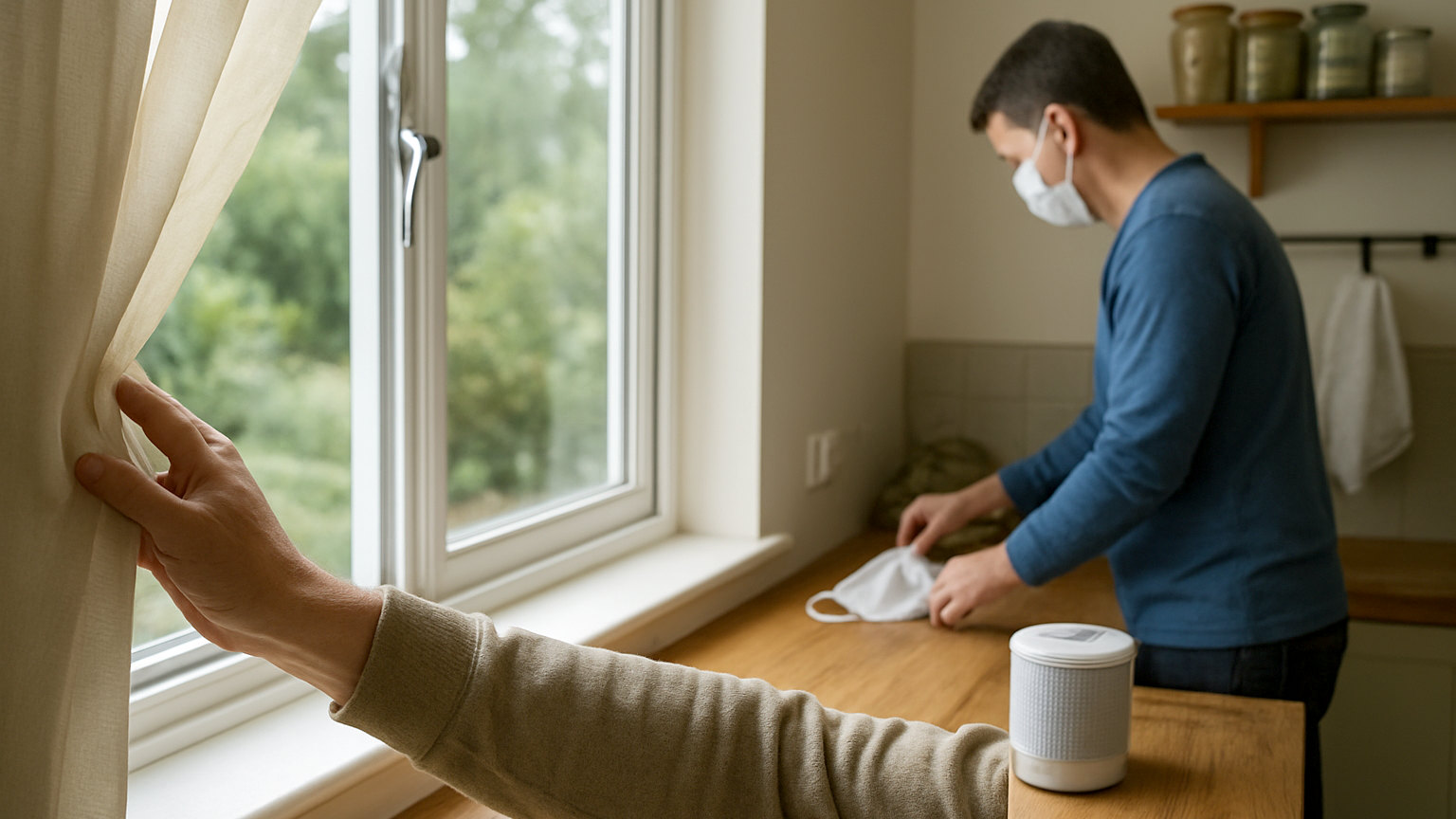
Ventilation first, then separation, then masks in shared spaces, then hand hygiene. Opening windows in a room an ill person has been in makes a measurable difference. Keeping them in a separate room reduces shared air. Those two do most of the work, and the cleaning regimes people invest heavily in do rather less for respiratory illness.
How does this apply practically?
By focusing effort where it works. Ventilate, prefer outdoors, reduce time in crowded indoor spaces during an outbreak, use a well fitting mask where appropriate, and wash hands properly, particularly before eating and after using the lavatory. That is a short list and it reflects where the evidence sits.
Does this apply to stomach bugs too?
Only partly, and the differences matter. Gastrointestinal infections such as norovirus spread mainly through contaminated hands, surfaces and food, and through particles produced by vomiting rather than by ordinary breathing. That shifts the emphasis onto hand washing with soap and water, cleaning surfaces properly and being careful with food preparation, where ventilation does comparatively little.
How long do people remain infectious?
It varies by infection and by person, and current NHS guidance is the source to follow rather than a remembered figure. As a general principle, infectiousness tends to peak around the onset of symptoms and decline afterwards, and people are frequently infectious before they feel unwell. That is why guidance during outbreaks addresses contacts as well as cases.
Air is the main route, indoors crowded and unventilated is the risk profile, ventilation and separation do most of the work, and outdoors is far safer.