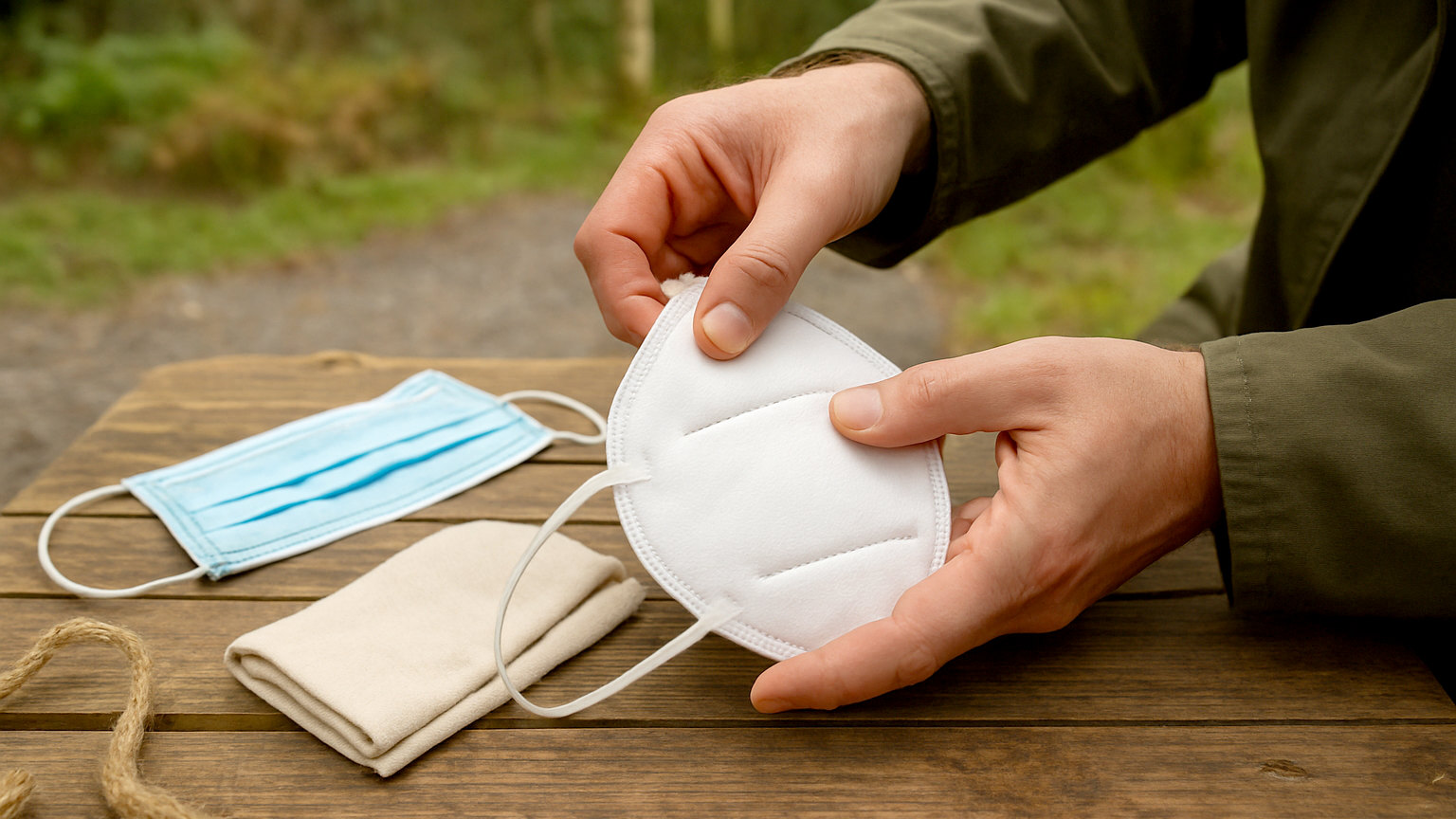
Masks vary enormously in what they do, and the differences between types are larger than the differences between wearing one and not. Fit is the factor most people overlook entirely.
What are the categories?
Respirators, meaning FFP2 and FFP3 in Europe or N95 and equivalents elsewhere, which are designed and tested to filter fine particles and to seal against the face. Surgical masks, designed principally to stop the wearer contaminating a sterile field, which offer moderate filtration and a loose fit. And cloth coverings, which vary from reasonable to negligible depending on material and construction.
Which filters best?
Respirators, by a substantial margin, both because the material is tested to a standard and because they are shaped to seal. A well fitted FFP2 or FFP3 filters a high proportion of fine particles. A surgical mask filters reasonably at the material and leaks around the edges. A single layer cloth covering does relatively little for fine aerosols.
- Respirators such as FFP2 and FFP3 filter best
- Surgical masks are moderate and leak around the edges
- Cloth coverings vary widely and are generally weakest
- Fit matters as much as the filtration rating
- Check for leaks around the nose and cheeks
- Beards prevent a respirator sealing properly
Why does fit matter so much?
Because air takes the easiest route. A respirator with a gap at the nose or cheeks allows unfiltered air straight past the filter, which negates most of the benefit however good the material. Mould the nose clip properly, check that the seal holds when you breathe in, and choose a size and shape that suits your face. Facial hair prevents a seal entirely.
Do they protect the wearer or others?
Both, in different proportions. Any mask provides some source control by capturing what the wearer exhales, which is why they were promoted early in outbreaks when supplies of respirators were limited. Respirators additionally protect the wearer meaningfully, which matters if you are the one caring for an ill person or if you are at higher risk yourself.
When are they worth wearing?
Where the risk profile is highest: indoors, crowded, prolonged, poorly ventilated. Public transport, healthcare settings, and shared rooms with someone unwell. A well fitting respirator in a busy indoor space during an outbreak is a reasonable and low cost precaution for anyone at higher risk, regardless of what others are doing.
How long can you use one?
Until it is damp, soiled, damaged or no longer seals. Respirators are generally intended for single or limited use, and performance degrades as the material becomes damp from breathing. Do not wash disposable respirators, which damages the filter media. Store a partially used one in a paper bag rather than sealed plastic if you intend to reuse it briefly.
What about valved respirators?
They protect the wearer and provide less source control, since the valve vents unfiltered exhaled air. That makes them unsuitable where the aim is to protect others, and they were excluded from many settings during recent outbreaks for that reason. For protecting yourself while caring for someone, they are effective and more comfortable.
What about children?
Adult respirators do not fit children and therefore do not seal. Smaller sizes exist for older children. Very young children should not wear masks at all for safety reasons. For households with young children, ventilation and separation are the measures that work, and mask use is not a realistic substitute.
How do you check the fit?
By feeling for leaks. Put it on, mould the nose clip firmly to the shape of your nose, then cup your hands over the mask and breathe in sharply. A well fitting respirator draws in slightly against your face and you should not feel air escaping around the edges, particularly at the nose and cheeks. If air leaks, adjust the straps and the nose clip, or try a different size or shape.
Choose a respirator over a surgical mask, make sure it seals at the nose and cheeks, wear it where the risk profile is highest, and replace it when damp.