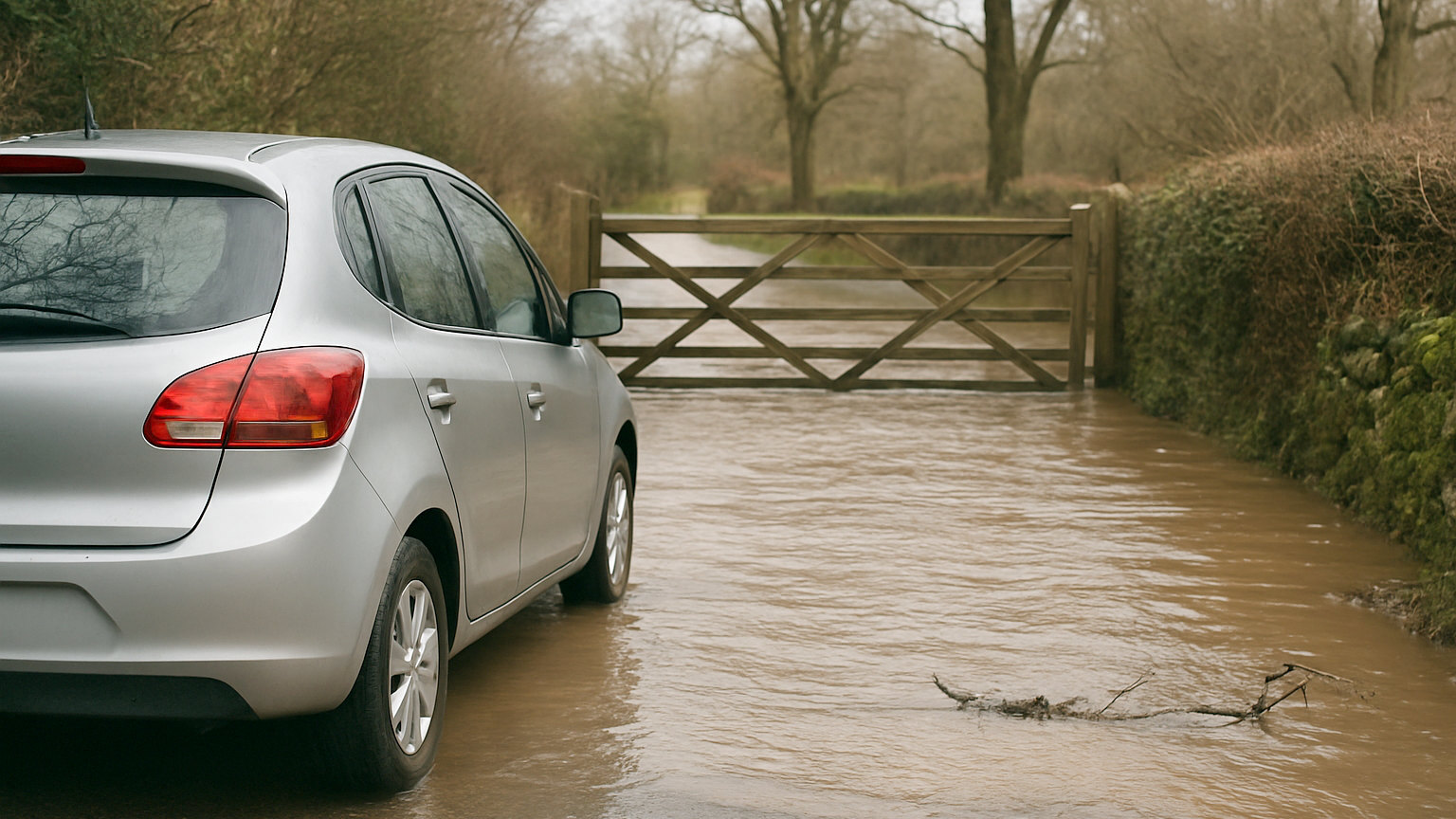
Driving into floodwater is the single most common fatal decision in British flooding, and it is made repeatedly by sensible people who underestimate what shallow moving water does to a vehicle.
How little water is dangerous?
Around thirty centimetres of moving water is enough to float most cars, and sixty centimetres will float almost any vehicle including four wheel drives. Fifteen centimetres of fast flowing water will knock an adult off their feet. These figures are consistently lower than people assume, and once a vehicle begins to float it goes wherever the water goes.
What is under the water?
Possibly nothing. Floodwater scours road surfaces and washes away material beneath them, so a road that looks intact can have collapsed under the water. Manhole and drain covers lift under pressure and leave open shafts. Debris, fallen branches and displaced objects are invisible. You cannot see any of this and there is no way to judge depth from a vehicle.
- Thirty centimetres of moving water floats most cars
- The road surface beneath may have washed away
- Manhole covers lift and leave open shafts
- Depth cannot be judged from inside a vehicle
- Turn around and find another route
- Vehicles are involved in a large share of flood deaths
Why do people do it anyway?
Because the water looks shallow, because someone else has just driven through, and because turning around means a long detour. Each of those is a poor reason. The vehicle in front may have been higher, the water may have deepened since, and a detour costs time while the alternative can cost considerably more. The correct response to floodwater across a road is to turn around.
What damage does it do to a car?
Frequently terminal, even where you get through. Water drawn into the engine causes hydraulic lock and destroys it, since water does not compress. Electrical systems, control modules and safety equipment are damaged by immersion. Insurers commonly write off flood damaged vehicles rather than repairing them, because the faults appear over months and cannot be reliably chased down.
What if your car stalls in water?
Get out immediately if you safely can, and move to higher ground. Do not stay in the vehicle waiting for help while water is rising, and do not attempt to restart the engine. Open the door while you still can, since water pressure makes doors difficult to open once levels rise, and the electric windows may fail. Leave the vehicle rather than trying to save it.
What if you cannot open the door?
Go through a window. Open it electrically at the earliest opportunity, since the system may fail once water reaches it, and break it if necessary using a purpose made escape tool kept within reach rather than in the glovebox. Side windows break far more readily than the windscreen, which is laminated. Free any children first, then leave together.
Does a larger vehicle help?
Less than owners believe. Higher ground clearance allows deeper wading, and buoyancy still applies, and a floating four wheel drive is no more controllable than a floating hatchback. Vehicles with a higher air intake fare better against engine damage and no better against the road having disappeared. Confidence in a capable vehicle is itself a risk factor.
What about walking through it?
Equally inadvisable. Fifteen centimetres of fast water will take an adult off their feet, open drains and manholes are invisible, and the water carries sewage, chemicals and debris. Children are at far greater risk. If you must move through standing water in an emergency, use a pole to test ahead of each step and avoid moving water entirely.
What about fords and known crossings?
Treat them with the same caution, since familiarity is exactly what catches people. A ford crossed regularly at normal levels behaves entirely differently after heavy rain, and depth gauges may be submerged or misleading. Fast flowing water over a ford is among the most dangerous crossings there is, because drivers assume their knowledge of the place substitutes for judgement about the conditions on the day.
Turn around rather than driving in, do not judge depth by appearance, leave a stalled vehicle immediately, and keep an escape tool within reach.