The advice looks almost too simple, and it is the product of decades of injury data and building performance research. Understanding why makes it far easier to do under stress.
What actually injures people?
Falling objects and falling over. In countries with engineered buildings and enforced codes, total collapse is rare and the injuries come from light fittings, ceiling tiles, bookcases, televisions, glass, and people being thrown to the floor while trying to move. The response therefore targets those hazards rather than collapse.
What does each word do?
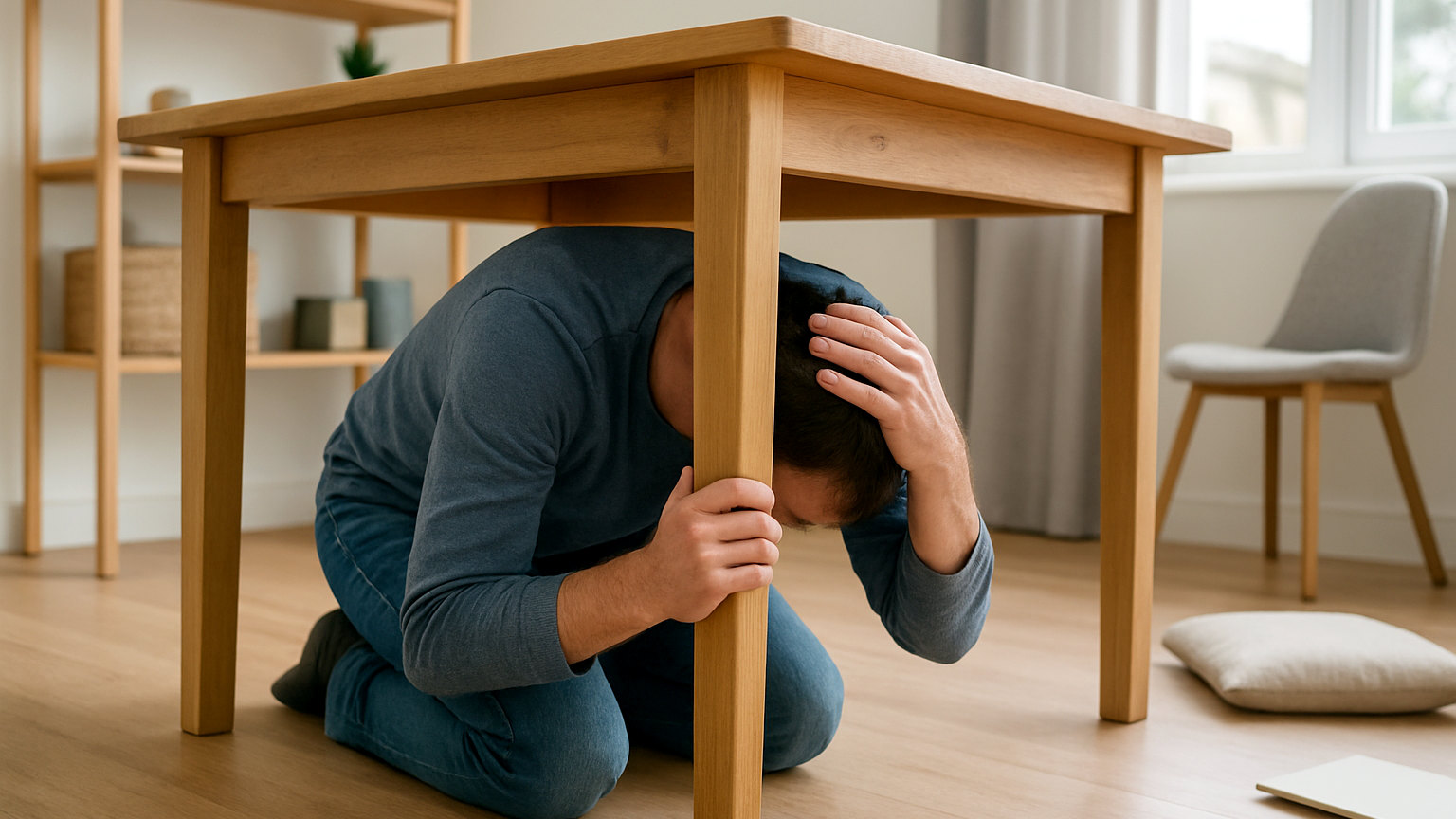
Drop protects you from being knocked over, since violent shaking makes standing impossible and falls cause fractures and head injuries. Cover protects your head and neck from anything falling, which is the most common source of serious injury. Hold on keeps your cover over you, because furniture slides across a shaking floor and a table you are not holding will move away from you.
- Drop prevents being thrown to the floor
- Cover protects the head and neck from falling objects
- Hold on keeps the cover in place as furniture moves
- Moving during shaking is when most injuries occur
- Adopted internationally by emergency agencies
- Practised annually in large scale drills worldwide
Who recommends it?
Essentially every national emergency management agency in a seismic country, along with the Red Cross and Red Crescent movement, earthquake engineering bodies and the international ShakeOut drill programme, which runs annually with millions of participants. The consistency across agencies with different building stock and different hazards is a strong indication that the advice is robust.
Why is it better than running?
Because you cannot run reliably on a shaking floor, and the route out passes under the most dangerous things. Doorways, corridors, stairwells and building exteriors all concentrate falling hazards. Studies of injuries consistently find that people who moved during shaking were hurt more often than those who took cover where they were.
Does it apply everywhere?
It is the standard advice, with an important qualification. In areas where buildings are unengineered, unreinforced masonry or adobe and collapse is a genuine likelihood, some agencies advise getting outside if you can do so within seconds and are on the ground floor. That is a judgement about local building stock rather than a rejection of the principle, and in modern buildings drop, cover and hold on remains correct.
How do you make it automatic?
By practising, briefly and occasionally. It takes ten seconds to run through in a room, and doing it once with children turns it into something they will do rather than something they have heard. Large scale drills exist precisely because a response practised in advance is far more likely to happen when the floor starts moving.
What should you do with children?
Teach it as a game and keep it short. Small children respond well to a simple three step action with a name, and schools in seismic countries drill it routinely. Explain that they should do it wherever they are rather than looking for a parent first, since crossing a room to reach an adult is the movement the advice exists to prevent.
What comes after?
Staying put until the shaking stops, then moving carefully with shoes on and expecting aftershocks. The advice is specifically about the shaking itself, and the period afterwards has its own priorities: checking for injuries, looking for gas leaks, and evacuating calmly if the building is damaged.
Does it work in a car or a wheelchair?
The principle adapts rather than changing. In a vehicle you pull over clear of structures and stay belted in, which is the equivalent of covering and holding on. In a wheelchair you lock the wheels and cover your head. In bed you stay put and cover with a pillow. The constant is protecting the head and neck without moving across a shaking floor, and the specific posture follows from where you are.
It targets falling objects rather than collapse, it is agreed internationally, and it works because it is short enough to do without thinking.