Standing in a doorway is the most persistent piece of earthquake advice in circulation and one of the least useful. It was reasonable once, for buildings almost nobody lives in now.
Where did the advice come from?
From photographs of collapsed adobe and unreinforced masonry buildings in which the doorframe was the only element left standing. In those structures the frame was genuinely the strongest part, and the observation was reasonable for that building type. The image was memorable, the advice spread, and it outlived the construction it described.
Why does it not apply now?
Because in a modern building the doorway is no stronger than the surrounding wall. Contemporary construction distributes loads through the whole structure rather than concentrating strength in openings, so a doorway confers no structural advantage. Standing in one puts you in a location with no protection from the hazard that actually injures people.
- The advice came from adobe and unreinforced masonry buildings
- Modern doorways are no stronger than the surrounding wall
- A doorway offers no protection from falling objects
- Swinging doors cause injuries during shaking
- Reaching a doorway means moving on a shaking floor
- Drop, cover and hold on replaced it decades ago
What is the specific hazard?
Falling objects, which a doorway does nothing about. Standing upright in an opening leaves your head and neck completely exposed to light fittings, ceiling material, glass and anything falling from above. In an engineered building those are the things that cause injury, and the whole point of taking cover is to put something solid between them and your head.
What about the door itself?
It is a hazard rather than a help. A door swinging violently on its hinges during shaking can strike and injure someone standing in the frame, and fingers are readily trapped. Interior doors are light and offer no protection while adding a moving object at head height, which is the opposite of what you want.
Why does the myth persist?
Because it is vivid, because it was taught for decades, and because it sounds structural in a way that appeals. Emergency agencies have been correcting it for many years and it continues to appear in films, in casual conversation and occasionally in dated material online. If you learned it at school, it is worth deliberately replacing rather than assuming you will remember the right thing under stress.
Does it ever make sense?
Only in the building type it came from, and only marginally. In an unreinforced adobe structure the frame may still be the strongest element, and even there agencies now generally advise getting outside if you can do so in seconds, or dropping and covering if you cannot. For anyone in a modern building anywhere in the world, the doorway is simply the wrong place.
What should you do instead?
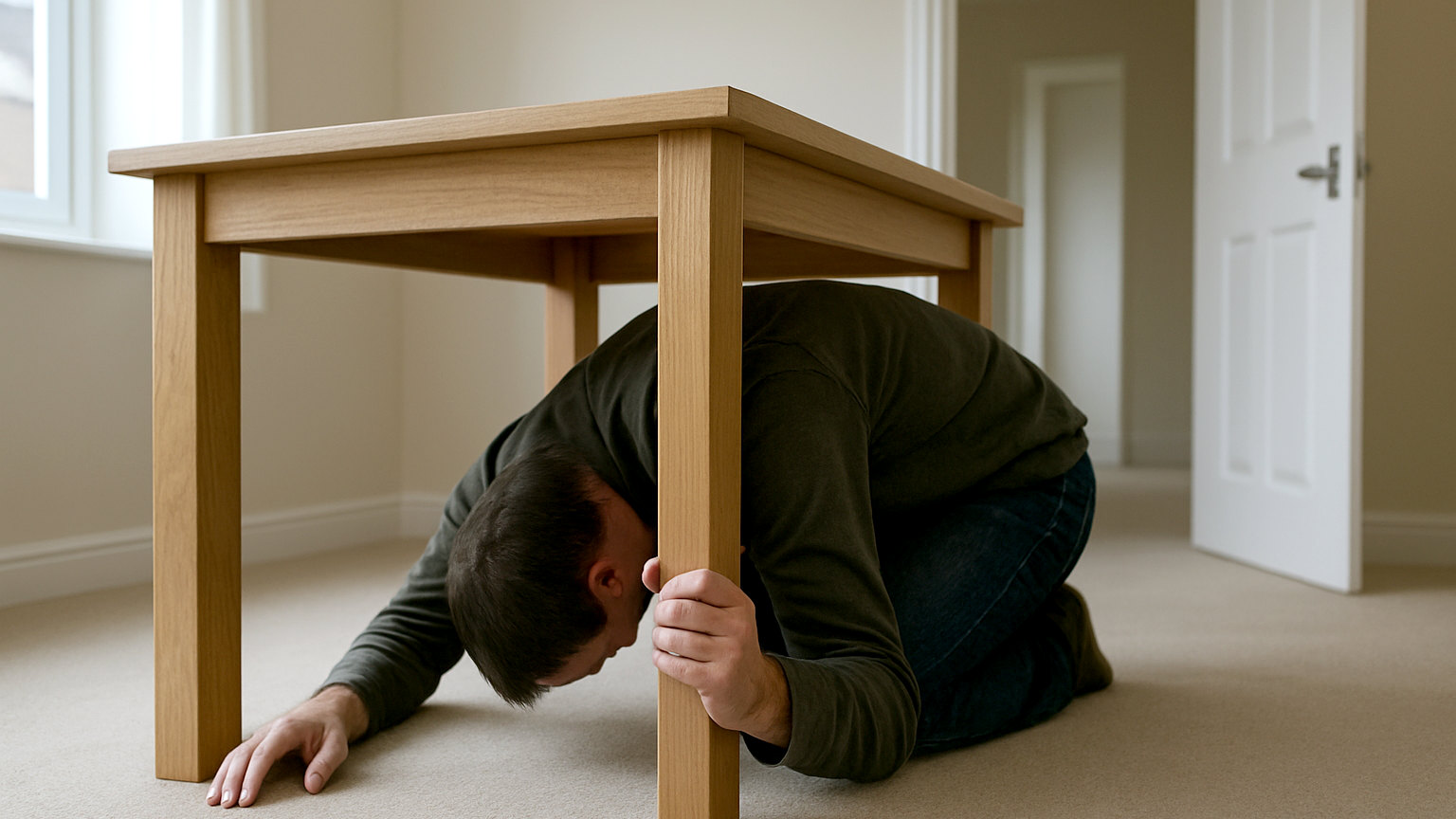
Drop, cover and hold on where you are. Get under a sturdy table, or down beside an interior wall away from windows with your head and neck covered by your arms. Do not cross the room to reach a doorway, since moving during shaking is itself the hazard the advice exists to avoid.
What else is worth unlearning?
The triangle of life, which suggests lying beside furniture rather than under it and has been rejected by emergency agencies and earthquake engineers. Also the idea of running outside, which is right only in specific unengineered building contexts and wrong in most. When advice contradicts what national emergency agencies publish, follow the agencies.
How do you correct it with family?
Say the replacement rather than only the correction, since people remember instructions better than negations. Teach drop, cover and hold on as the thing to do, mention once that doorways are outdated, and then practise the correct action. Children in particular will follow a positive instruction they have rehearsed far more reliably than they will avoid something they were told not to do.
Doorways protect nothing in a modern building, the door itself is a hazard, and drop, cover and hold on replaced the advice decades ago.