The response to shaking is settled internationally and is simpler than most people assume. The difficulty is that the instinct to run contradicts it.
What is the advice?
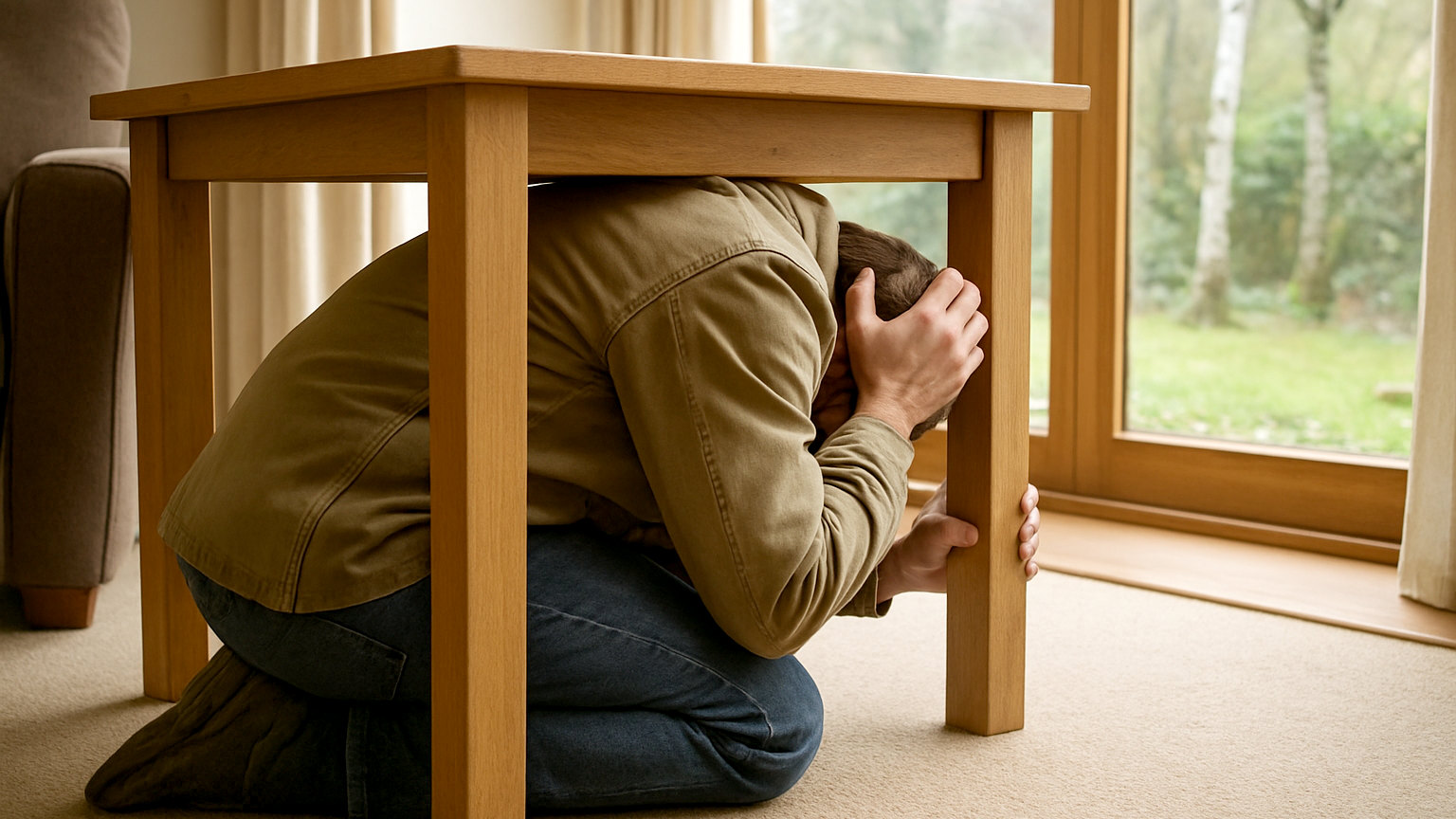
Drop, cover and hold on. Drop to your hands and knees before the shaking knocks you down. Cover your head and neck, ideally by getting under a sturdy table or desk. Hold on to it so it stays over you as the shaking moves it. Stay there until the shaking stops entirely, then move carefully.
Why not run outside?
Because moving during shaking is when people fall and when objects hit them. In modern engineered buildings the structure is unlikely to collapse, and the hazards are falling light fittings, bookcases, glass and masonry from facades. Running to a door or a stairwell puts you under exactly those things while the floor is moving. Most earthquake injuries in developed countries are from falling objects rather than collapse.
- Drop to hands and knees before you are knocked over
- Cover your head and neck, under a table if possible
- Hold on so the cover stays over you
- Stay where you are until the shaking stops
- Do not run outside or use lifts
- Stay in bed and cover your head if you are asleep
What if there is no table?
Get down next to an interior wall away from windows, cover your head and neck with your arms, and stay low. Avoid anything tall, heavy or glazed. If you are near a sturdy piece of furniture that will not topple, get beside it rather than under something flimsy. The priority is protecting your head and neck and not being knocked over.
What if you are in bed?
Stay there and cover your head with a pillow. Getting up in the dark on a moving floor with broken glass on it causes more injuries than staying put. The exception is if there is a heavy light fitting, mirror or picture directly above the bed, in which case move to the side of the bed and cover your head. That is also an argument for not hanging heavy things over beds in seismic countries.
What about the triangle of life?
Disregard it. The theory suggesting people should lie beside furniture rather than under it has been rejected by the American Red Cross, national emergency agencies and earthquake engineers, and it is based on collapse patterns in unengineered buildings rather than on how modern structures behave. Drop, cover and hold on remains the official advice everywhere it has been examined.
What if you are outside?
Move to open ground away from buildings, walls, trees, power lines and anything that could fall, then drop and cover your head. The most dangerous place outside is immediately beside a building, where facade material, glass and roof tiles come down. If you cannot reach open ground, get against a wall away from windows rather than running.
How long does shaking last?
Usually seconds to a minute, which is far shorter than it feels. Very large events can shake for several minutes. Either way, the correct response is to hold position until it stops rather than trying to judge whether it is finishing, since shaking commonly intensifies before it eases.
What do you do when it stops?
Expect aftershocks and move carefully. Put on shoes before walking anywhere, since broken glass is the most common injury afterwards. Check yourself and others, look for hazards, and evacuate calmly by the stairs if the building is damaged. Do not use lifts, and be ready to drop and cover again.
What if you use a wheelchair?
Lock the wheels, stay seated, and cover your head and neck with your arms or anything to hand. Transferring to the floor during shaking is usually more dangerous than remaining in the chair, particularly if you would then be unable to get back up. Move away from windows and tall furniture if you can do so in seconds, then lock, cover and hold on.
What about in a shop or public building?
Take cover where you are rather than heading for the exit with everyone else. Move away from shelving and glazed frontages, get down and protect your head. Crowd surges at exits injure people independently of the shaking.
Drop, cover and hold on where you are, do not run outside, stay in bed with your head covered, and ignore the triangle of life.