An out of area contact is one of the cheapest and most effective elements of any household plan. It costs a conversation with a relative or friend and solves a problem that catches households out repeatedly.
What problem does it solve?
Local network congestion. In a local emergency, everyone in the affected area attempts to call everyone else simultaneously, and the local cells saturate long before the wider network does. Calls between two people inside the affected area frequently fail, while a call out of the area often connects normally. A contact elsewhere can therefore receive messages from each household member and pass them on, when those members cannot reach each other directly.
Who should it be?
Someone at least fifty miles away, reliable, likely to be reachable, and willing to take the role. A relative or close friend in another region is ideal. They should be someone every household member knows how to contact, including children, and someone who will answer an unfamiliar number. Choosing two, in different places, is better still, since one may be away or unwell.
- Choose someone well outside your region, fifty miles or more
- Make sure every household member has the number memorised or carried
- Ask them explicitly and explain what the role involves
- Give them your household plan and a list of who might call
- Agree that texts are preferred over calls
- Check in with them annually to confirm details are current
What should they actually do?
Take messages and relay them. Each household member contacts the out of area person to report where they are and that they are safe, and that person tells everyone else. They do not need to solve anything or make decisions. Giving them a copy of your plan lets them answer questions such as which meeting point was agreed, and lets them contact a school or an employer if you cannot.
Why should everyone memorise the number?
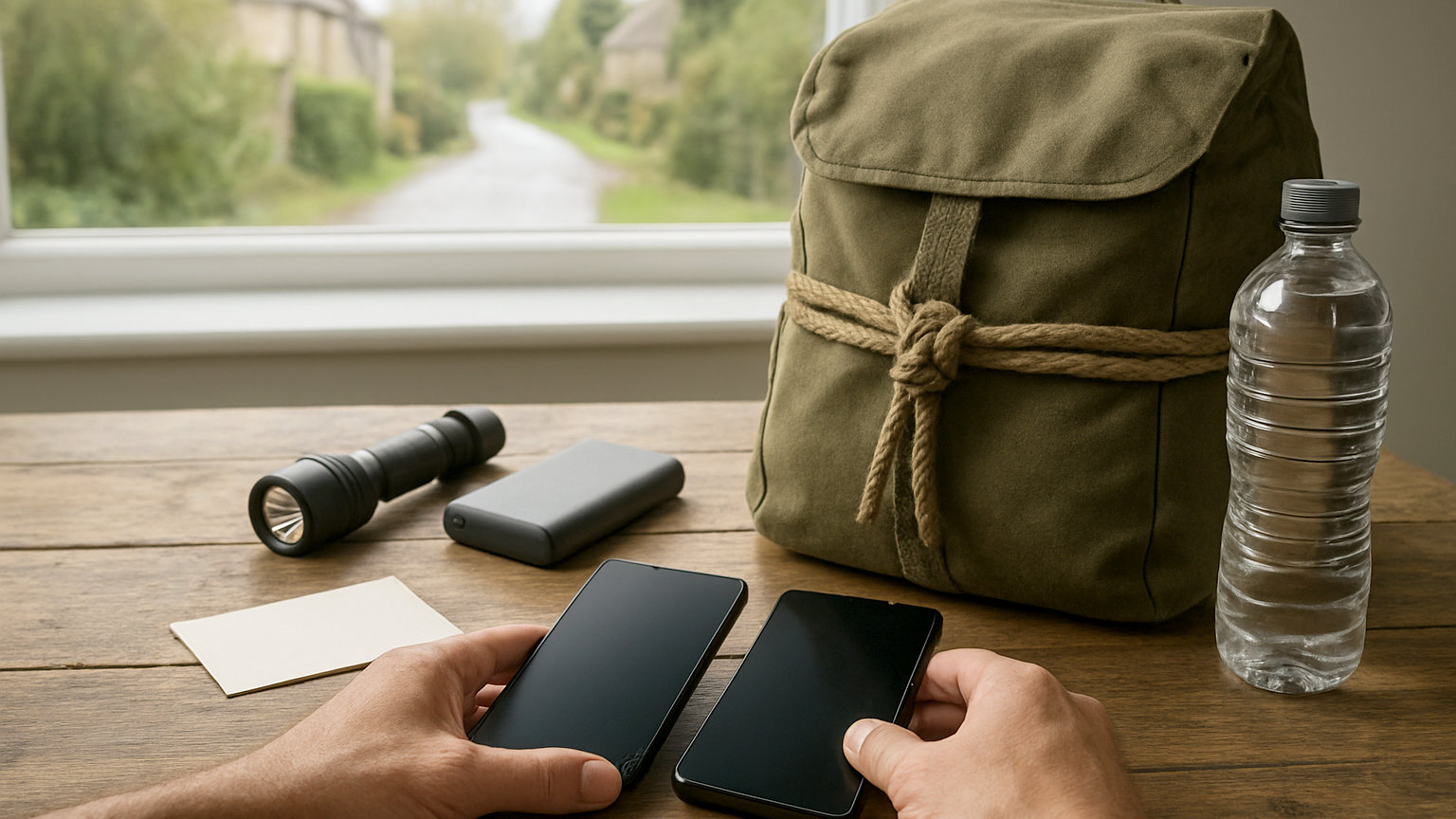
Because a phone can be lost, broken, flat or left behind, and almost nobody knows any number by heart any more. A child separated from a parent with a borrowed phone needs a number they can recall. Write it on a card in each wallet and school bag, and get children to learn it the way previous generations learned a home phone number. This single step covers a surprising range of situations.
Does texting work better than calling?
Substantially, in congested conditions. A text is a small packet that queues and retries automatically, while a call needs a sustained connection for its whole duration. Agreeing in advance that everyone texts rather than calls both preserves network capacity for emergency traffic and increases the chance your own message gets through. Keep messages short for the same reason.
What if the networks are down entirely?
Then the relay does not work and the meeting points and the plan carry the load, which is why both exist. Widespread network failure is rarer than congestion but does occur after severe storms and power cuts, since mobile masts have limited battery backup. This is the argument for having a physical fallback: an agreed meeting point, a note left at home, and neighbours who know your arrangements.
How does this fit with the rest of the plan?
It is the communications layer, and it works alongside the meeting points rather than instead of them. The usual sequence is to try contacting the out of area person, then to go to the agreed meeting point if that fails, and to leave a note at home saying where you have gone. Between them these cover most realistic separations.
Does this apply to widespread emergencies too?
Less reliably, which is worth understanding. In a genuinely national event, congestion is not confined to one region and a contact fifty miles away may be as unreachable as one next door. The out of area arrangement is designed for local incidents, which is what the overwhelming majority of emergencies are. For wider events, the meeting points and the agreement to make your own way there carry the load, which is why the plan should never rest on communications alone.
Pick someone far away, ask them properly, and make sure the youngest person in the house knows the number without looking it up.