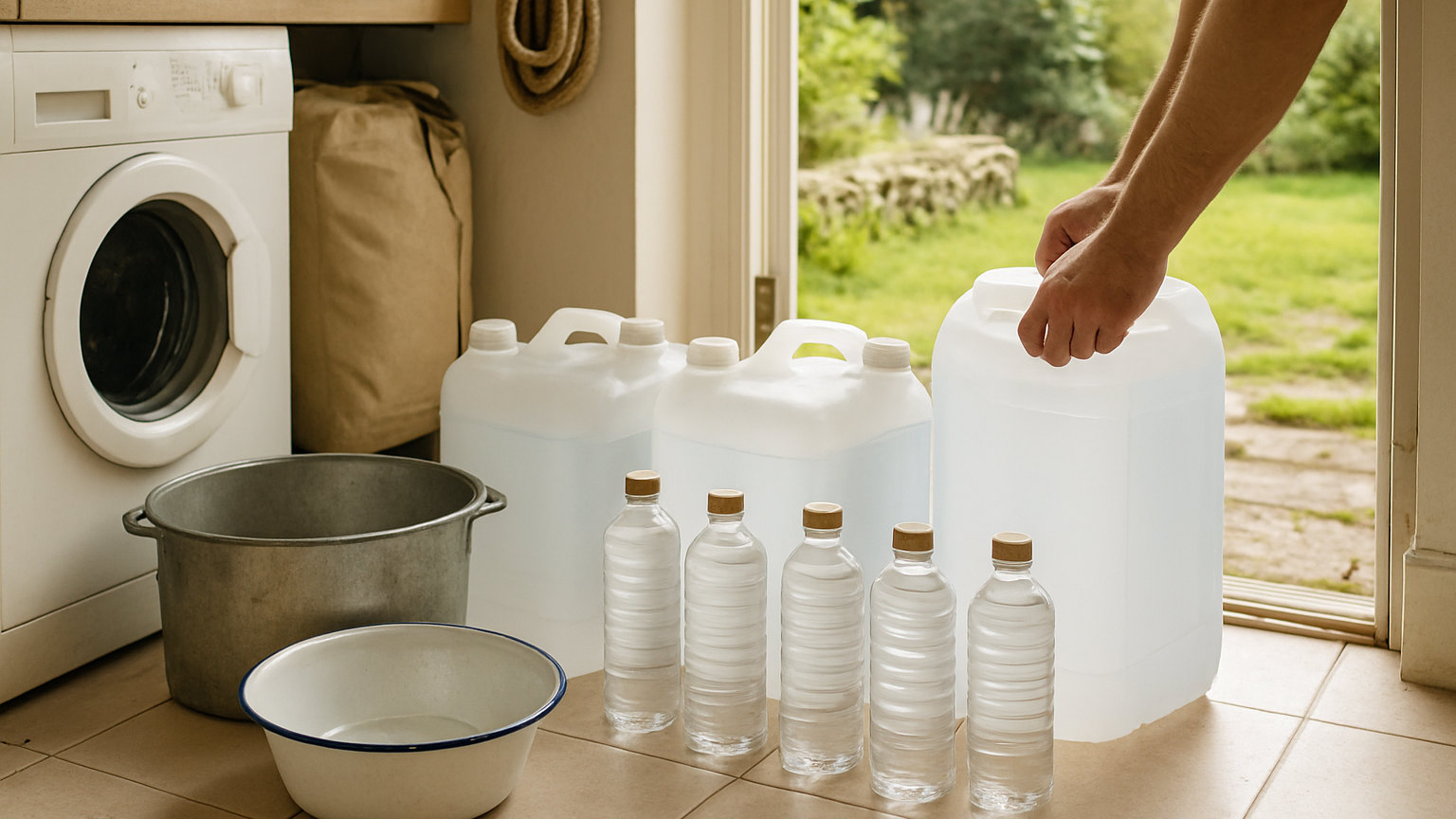
Water is the supply that runs out first in almost every scenario, and it is the one people most consistently underestimate. It is also heavy, bulky and awkward, which is why the recommended quantity surprises people when they see it stacked up.
How much do you actually need?
Three litres per person per day for drinking, and a further one to two litres for cooking and basic hygiene. Planning at four litres per person per day is a sensible figure for a household store. For a family of four over seven days that is around one hundred and twelve litres, which is roughly fifty six two litre bottles, or a stack of crates that takes up real space under a bed or in a garage.
What should you store it in?
Commercially bottled water is the simplest answer, since it is sealed, dated and requires no preparation. For larger volumes, food grade containers designed for drinking water work well, including collapsible carriers that store flat. Avoid reusing milk bottles, which retain protein residues and encourage bacterial growth, and avoid any container that has held anything other than food or drink.
- Four litres per person per day covering drinking and basic use
- Minimum three days, ideally seven
- Commercially bottled water or food grade containers
- Store cool, dark and off concrete floors
- Rotate annually and note the date on each container
- Include water for pets, which is easily forgotten
How long does stored water keep?
Commercially bottled water keeps for years, and the date printed on it relates to the plastic and taste rather than safety. Water you have bottled yourself from a mains supply should be rotated annually, since it is not sterile and containers are rarely perfectly sealed. Store everything away from sunlight, which encourages algae, and away from chemicals and fuels, since some plastics allow vapours to permeate and taint the contents.
Where should you keep it?
Cool, dark and spread across more than one location. Under beds, in a cupboard, in a garage and in a shed all work, and splitting the store means a single problem does not remove all of it. Keep bottles off bare concrete on a board or pallet, since concrete transfers cold and moisture and can affect plastic over long periods. Make sure at least some is somewhere you could carry it from easily.
What should you do when a warning is issued?
Fill everything immediately, while pressure remains. Supply frequently degrades before it fails entirely, so the window can be short. Fill the bath, which holds well over a hundred litres and is invaluable for flushing lavatories, plus every pan, jug, kettle and bottle in the house. Bath water is not for drinking, and the toilet flushing use is the one households most consistently overlook.
Does the water need treating?
Not if it came from a clean mains supply into a clean sealed container. If there is any doubt, or if a boil water notice is in force, boil it for one minute and let it cool covered. Keeping a small supply of purification tablets alongside the stored water is cheap insurance and covers the case where you are collecting from an uncertain source.
What about a water butt?
Useful for flushing, washing and garden use, and not suitable for drinking without proper treatment. Roof runoff picks up bird droppings, debris and material from the roofing itself. It substantially extends what you can do during an interruption, since a great deal of household water use is not drinking, and it takes pressure off your stored drinking supply.
How do you carry it if you have to move?
Badly, which is the point worth planning around. Water weighs a kilogram per litre, so a family day supply is twelve kilograms before anything else. Collapsible carriers with handles are far easier to move than loose bottles, and a few smaller bottles are more practical than one large container that nobody can lift. If evacuation is a realistic risk where you live, keep a portion of the store in containers one person could actually carry to a car.
Store four litres per person per day for a week, keep it cool and dated, and fill the bath the moment you hear there is a problem.