Britain has moved decisively toward card and contactless payment, and many people now carry no cash at all. That is convenient right up to the point where the shop has no power, the card terminal has no connection and the cash machine outside is dark.
Why does electronic payment fail?
Because it depends on a chain of systems that all need power and connectivity. The till, the card terminal, the shop broadband, the mobile network the backup connection uses and the bank systems at the far end. A local power cut takes out the first three at once. Cash machines fail for the same reason, and those that keep working are quickly emptied. Payment system outages also occur independently of any wider emergency.
How much should you keep?
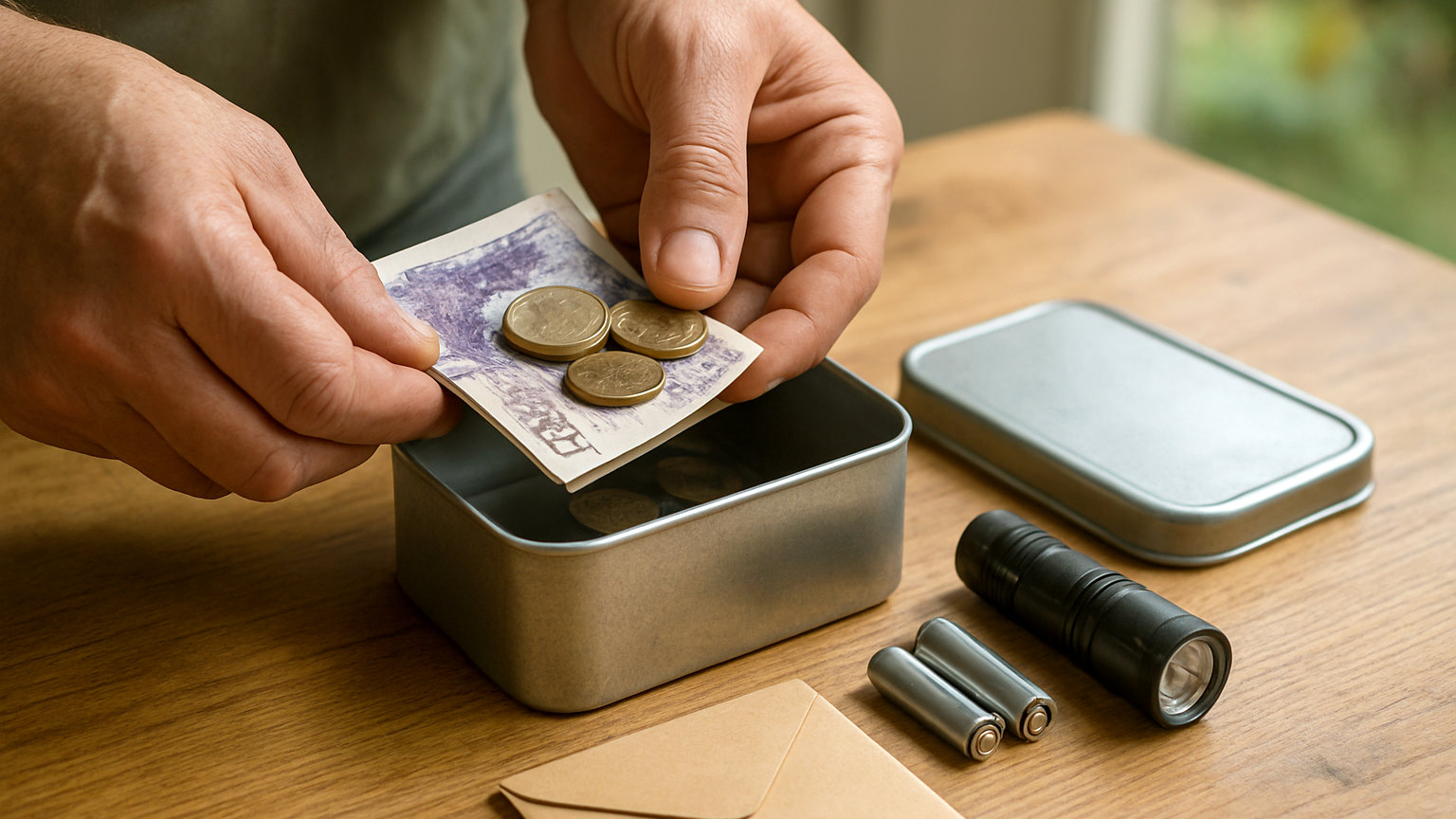
Enough for a few days of essentials, which for most households means somewhere between fifty and two hundred pounds. The right figure depends on household size and circumstances, and the aim is buying food, fuel and immediate necessities rather than funding an extended period. Keeping considerably more at home introduces theft and insurance issues that outweigh the benefit.
- Enough for a few days of essentials, not a large reserve
- Mostly small notes, since change may be unavailable
- Some coins for parking, payphones and vending
- Split between two hidden locations rather than one
- Include some in the grab bag as well as at home
- Check your home insurance limit for cash on the premises
Why do denominations matter?
Because a shop running on a calculator and a cash tin during a power cut may not be able to change a fifty pound note. Small notes and a bag of coins are considerably more useful than the same value in large denominations. Coins also cover parking meters, payphones and vending machines, all of which may be the only working option for something you need.
Where should you keep it?
Split across two discreet locations, neither of them the obvious one. A bedside drawer and a jewellery box are the first places anyone looks. Consider a small safe bolted down, or two separate hiding places so that a single discovery does not remove everything. Some should live in the grab bag, since an evacuation may mean leaving without visiting your hiding place.
Does insurance cover it?
Up to a limit, which is usually low. Most home contents policies cap cash cover at a few hundred pounds and may require it to be in a locked safe for higher amounts. Check your policy wording before deciding how much to keep, and be aware that cash is rarely covered at all if the loss cannot be evidenced. This is another argument for keeping the amount modest.
What about petrol stations?
They are a specific weak point worth knowing about. Fuel pumps are electrically powered and stop entirely in an outage, so a station with power and no card connectivity can still sell fuel for cash while one without power can sell nothing. During disruptions, fuel becomes a bottleneck quickly, and keeping the car reasonably fuelled is a better strategy than relying on being able to fill up when something happens.
Should you also hold cash abroad?
If you travel, yes, in the local currency and in small amounts. Card systems fail in other countries too, and being somewhere unfamiliar with no working payment method is considerably worse. A modest reserve of local notes, kept separately from your wallet, covers transport and food while you sort out a longer term solution.
Does everyone in the household need some?
Anyone who might be away from home when something happens, which usually means every adult and older teenager. A twenty pound note tucked into a phone case, a bag or a coat pocket covers a bus fare, a taxi, a meal or a phone charge for someone stranded at work or school. It is the smallest possible piece of preparedness and it addresses the most common scenario, which is being separated rather than being at home together.
Keep a few days of essentials in small notes, split it between two places, put some in the grab bag, and check your insurance limit.