Handheld radios occupy a useful niche in emergency communications: they work with no network, no infrastructure and no subscription, over a distance that suits a household or a small group.
What is PMR446?
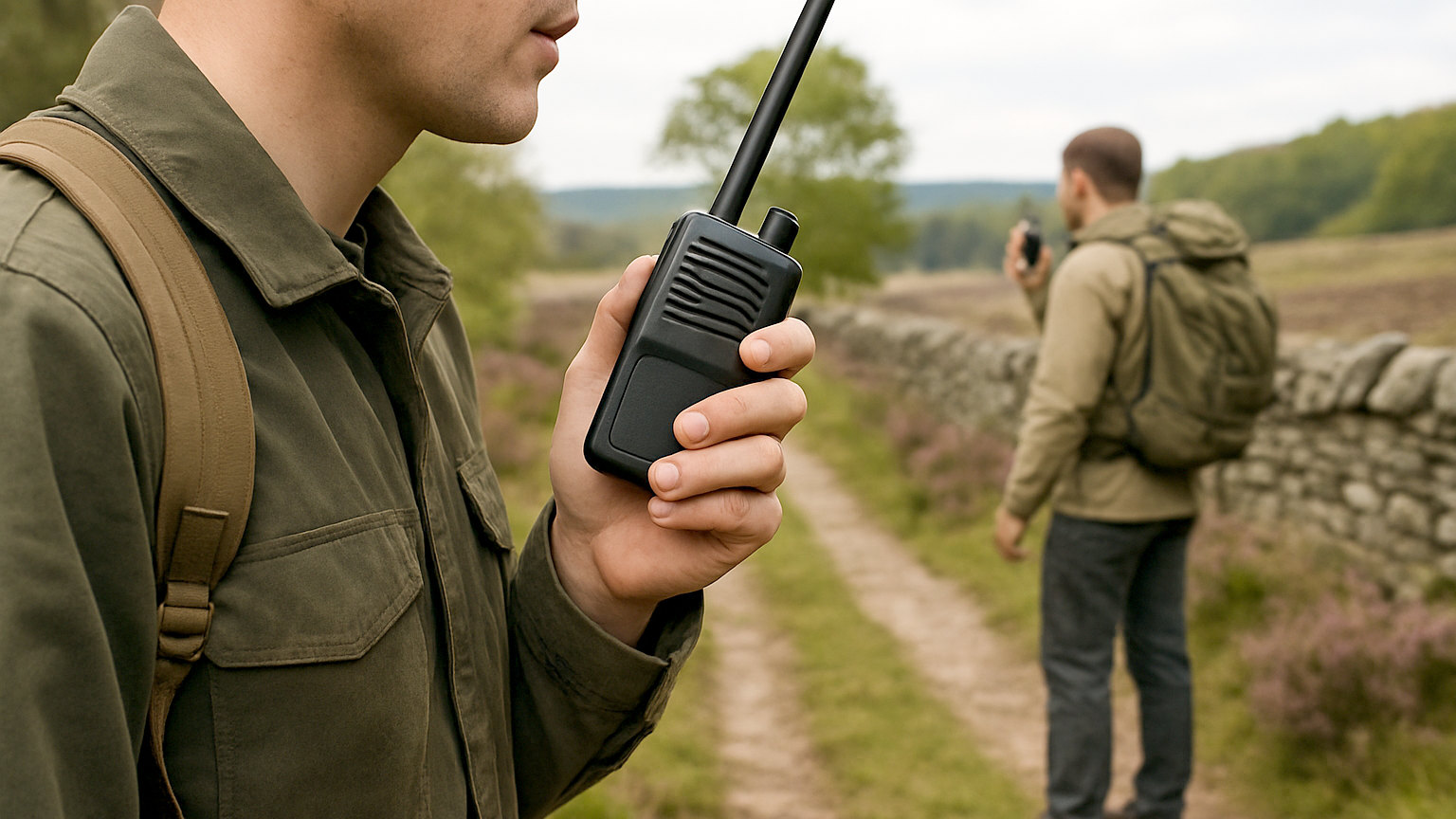
A licence free radio service available across Europe including the United Kingdom, operating on a set of channels around four hundred and forty six megahertz at low power. No licence, registration or fee is required, and the radios are sold in pairs in high street shops and online. They are the same category of device used on building sites, at events and by families on ski trips.
What range do they actually achieve?
Far less than the box says. Packaging claiming ten kilometres refers to ideal conditions such as hilltop to hilltop with nothing in between. In a built up area expect a few hundred metres to perhaps two kilometres. Across open countryside with line of sight, several kilometres is achievable. Buildings, trees and terrain all reduce it sharply, since these frequencies travel in straight lines and do not bend around obstacles.
- No licence, registration or subscription required
- Realistic range is hundreds of metres to a few kilometres
- Line of sight matters more than the advertised power
- Anyone nearby on the same channel can hear you
- Rechargeable models need charging, so keep spare batteries
- Agree a channel with your household in advance
What are they genuinely useful for?
Keeping a group in contact where mobile networks are congested or absent. Coordinating within a large property or a farm. Keeping in touch during an evacuation when a household is split between vehicles. Communicating with neighbours on the same street during an outage. Any situation where the distance is short and the network is unreliable.
What are the limitations?
Range, privacy and discipline. Anyone within range on the same channel hears everything you say, so nothing sensitive should be discussed. Only one person can transmit at a time, so a group needs basic radio discipline to avoid talking over each other. And they need charging, which is a problem during a power cut unless you have spare batteries or a way to charge them.
Which should you buy?
Models taking standard AA or AAA batteries as well as rechargeables, which removes the charging problem entirely during an outage. Look for a decent number of channels, a belt clip, and reasonable water resistance. Cost is modest. Avoid being drawn in by advertised range figures, which are close to meaningless, and buy on build quality and battery flexibility instead.
What about CB radio?
Also licence free in the United Kingdom and covering longer distances, since it uses lower frequencies that travel further and cope better with terrain. Equipment is bulkier and more often vehicle mounted, and there is an active community of users. For a household wanting simple short range contact, PMR446 is easier. For vehicle to vehicle over longer distances, CB has advantages.
How should you use them in a group?
With agreed conventions. Pick a channel in advance and write it in the household plan. Keep transmissions short. Say who you are calling and who you are before the message. Wait a moment after pressing transmit before speaking, since the first syllable is often clipped. Agree check in times rather than leaving radios on constantly, which drains batteries quickly.
Are they worth having?
For some households, yes. If your household is spread across a large property, if you have a smallholding, if you live somewhere with poor mobile coverage, or if you regularly travel in convoy, they earn their place. For a household in a town who would all be in the same house, they are a low priority compared with power banks and a radio.
How do you extend the range?
Height, more than anything else. Because these frequencies travel in straight lines, getting the radio higher does far more than any setting on the device. Standing on a rise, at an upstairs window or in the open rather than behind a building can double the usable distance. Holding the radio vertically and away from your body helps, and a hand held at chest height with the antenna upright outperforms one held low or horizontally.
Buy models taking AA batteries, agree a channel in advance, expect a fraction of the advertised range, and keep transmissions short.